The Moon
The Moon is Earth’s only natural satellite—a rocky, cratered body about one‑quarter the diameter of Earth, orbiting at an average distance of approximately 384,400 km. It influences tides, stabilizes Earth’s axial tilt, and was formed about 4.5 billion years ago following a collision between Earth and a Mars-sized object.
Source: science.nasa.gov
APODs including "The Moon"
Diamonds in a Cloudy Sky
08/08/2009
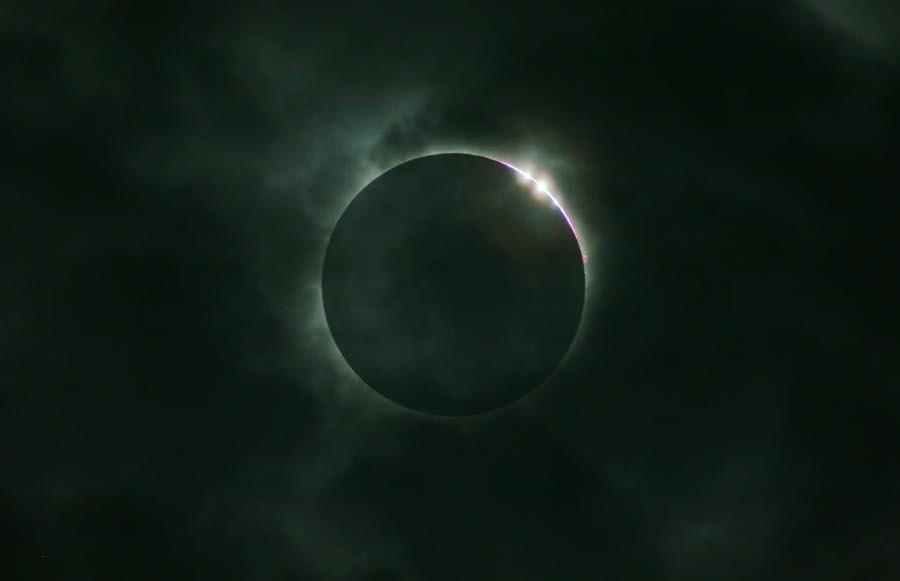
Cloudy skies over Wuhan, China hid the delicate solar corona during July's total eclipse of the Sun. Still, the Moon's silhouette was highlighted by these glistening diamonds as the total eclipse phase ended. Caused by bright sunlight streaming through dips and valleys in the irregular terrain along the Moon's edge, the effect is known as Baily's Beads, named after Francis Baily who called attention to the phenomenon in 1836. The dramatic appearance of the beads at the beginning or end of a total solar eclipse is also known as the Diamond Ring effect. In this remarkable image, a small, pinkish solar prominence can also be seen along the edge, below the diamonds.