The Moon
The Moon is Earth’s only natural satellite—a rocky, cratered body about one‑quarter the diameter of Earth, orbiting at an average distance of approximately 384,400 km. It influences tides, stabilizes Earth’s axial tilt, and was formed about 4.5 billion years ago following a collision between Earth and a Mars-sized object.
Source: science.nasa.gov
APODs including "The Moon"
Moon and Planets in the Morning
22/10/2009
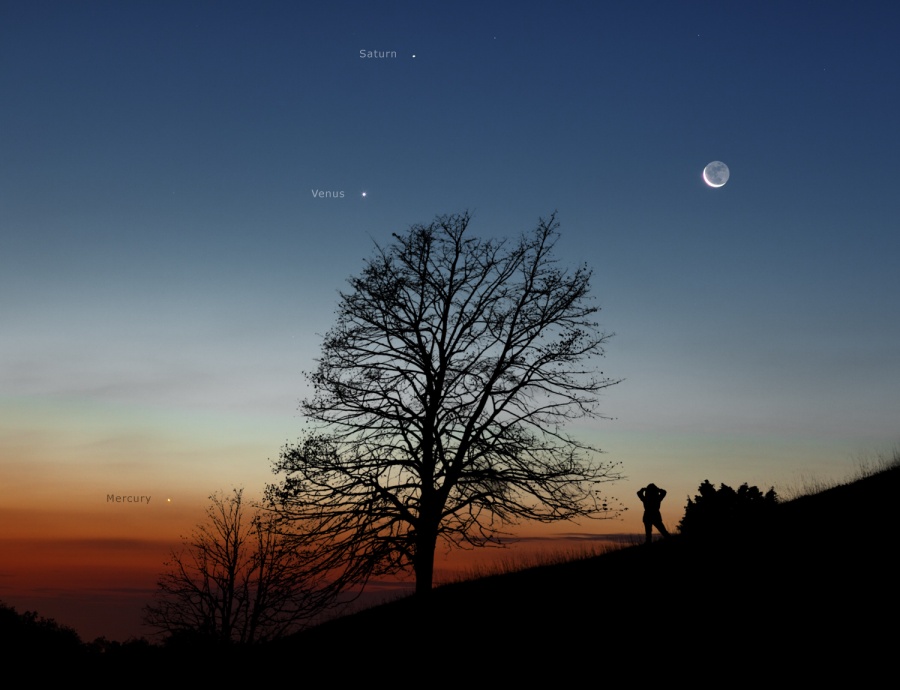
Last Friday, a gathering of three bright planets and the Moon graced the morning sky. With Mercury, Venus, Saturn, and a narrow lunar crescent close to the eastern horizon in the dawn twilight, this picture of the beautiful conjunction was recorded near Noerdlingen, Germany. These planets are wandering apart now and Mercury is sinking closer toward the rising Sun. But if you also scan the rest of the sky this week you should be able to add Jupiter and Mars to your planet spotting list, as Mars rises around midnight and Jupiter shines brightly after sunset. In fact, if you want a better view of Jupiter than Galileo had, you might check out the 2009 International Year of Astronomy activities and events during these next few Galilean Nights (October 22-24).