The Moon
The Moon is Earth’s only natural satellite—a rocky, cratered body about one‑quarter the diameter of Earth, orbiting at an average distance of approximately 384,400 km. It influences tides, stabilizes Earth’s axial tilt, and was formed about 4.5 billion years ago following a collision between Earth and a Mars-sized object.
Source: science.nasa.gov
APODs including "The Moon"
A Galilean Night
23/10/2009
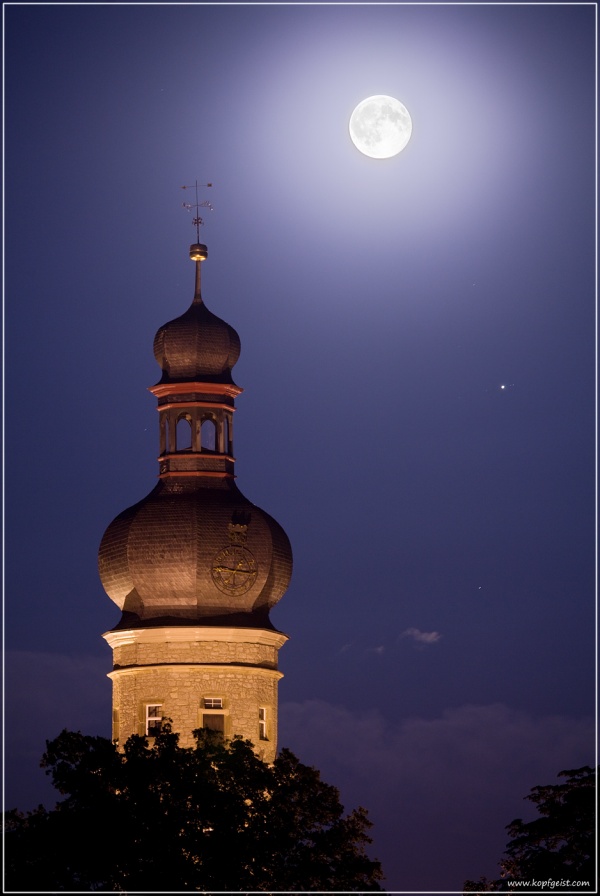
Driving along on a summer evening, near the small town of Weikersheim in southern Germany, photographer Jens Hackmann had to stop. He couldn't resist pointing his camera and telephoto lens at this lovely conjunction of a Full Moon and planet Jupiter looming near the steeple of a local church. Of course, 400 years ago, Galileo couldn't resist pointing his newly constructed telescope at these celestial beacons either. When he did, he found craters and mountains on the not-so-smooth lunar surface and discovered the large moons of Jupiter now known as the Galilean Moons. Jupiter's Galilean moons are just visible in this photo as tiny pinpricks of light very near the bright planet. Want to see the Moon and Jupiter better than Galileo? Look for local 2009 International Year of Astronomy activities and events during these next few Galilean Nights (October 22-24).