The Moon
The Moon is Earth’s only natural satellite—a rocky, cratered body about one‑quarter the diameter of Earth, orbiting at an average distance of approximately 384,400 km. It influences tides, stabilizes Earth’s axial tilt, and was formed about 4.5 billion years ago following a collision between Earth and a Mars-sized object.
Source: science.nasa.gov
APODs including "The Moon"
A Fading Moonset Over Hong Kong
15/12/2009
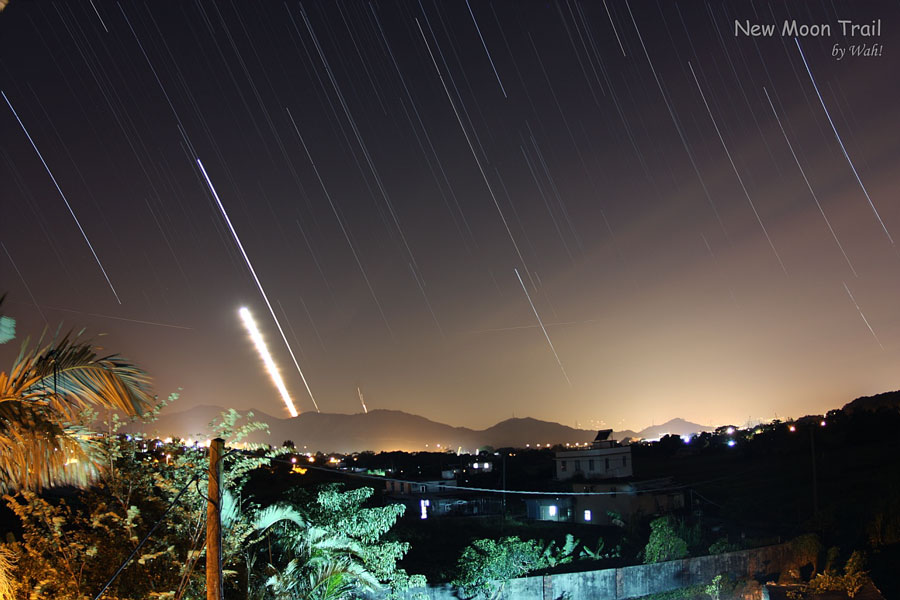
Do stars appear dimmer when nearer the horizon? Yes -- atmospheric air absorbs and reradiates light, so that the greater the airmass through which one peers, the fainter an object will appear. Pictured above in a multi-frame image, stars, the planet Jupiter, and even the Moon show the horizon-dimming effects of Earth's nearly-transparent atmosphere. The image was taken in the evening about three weeks ago over Hong Kong, China. The brightest streak near the center is the setting Moon, while intermittent thin clouds sometimes dispersed moonlight into a larger halo. Jupiter sets just to the Moon's right. The dim steaks cutting across the image horizontally were caused by passing airplanes. The bright strange multi-pronged streak over the house is a helicopter taking off. An astute observer will also notice faint rays emanating from near the horizon. Their cause is unknown, but may be crepuscular rays caused by the Sun shining through gaps in thick clouds. New Mirror: APOD now available in Romanian from Romania