The Moon
The Moon is Earth’s only natural satellite—a rocky, cratered body about one‑quarter the diameter of Earth, orbiting at an average distance of approximately 384,400 km. It influences tides, stabilizes Earth’s axial tilt, and was formed about 4.5 billion years ago following a collision between Earth and a Mars-sized object.
Source: science.nasa.gov
APODs including "The Moon"
Saturn's Moon Helene from Cassini
10/03/2010
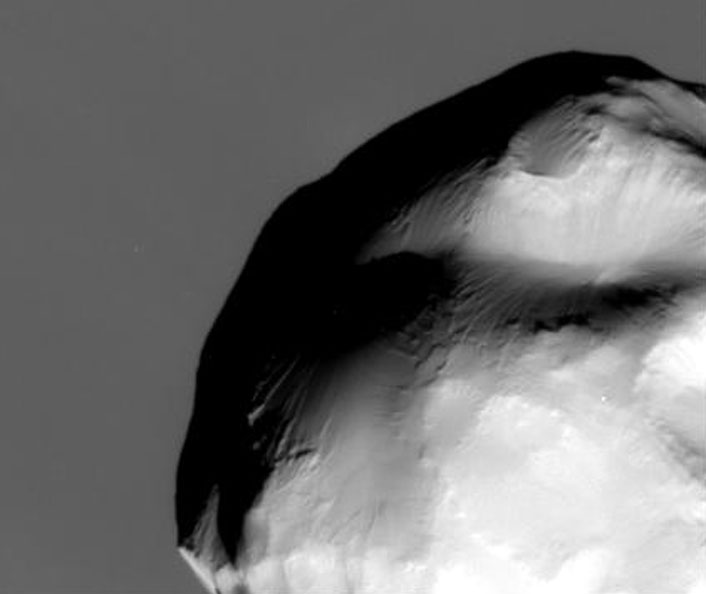
What's happening on the surface of Saturn's moon Helene? The moon was imaged in unprecedented detail last week as the robotic Cassini spacecraft orbiting Saturn swooped to within two Earth diameters of the diminutive moon. Although conventional craters and hills appear, the above raw and unprocessed image also shows terrain that appears unusually smooth and streaked. Planetary astronomers will be inspecting these detailed images of Helene to glean clues about the origin and evolution of the 30-km across floating iceberg. Helene is also unusual because it circles Saturn just ahead of the large moon Dione, making it one of only four known Saturnian moons to occupy a gravitational well known as a stable Lagrange point.