The Moon
The Moon is Earth’s only natural satellite—a rocky, cratered body about one‑quarter the diameter of Earth, orbiting at an average distance of approximately 384,400 km. It influences tides, stabilizes Earth’s axial tilt, and was formed about 4.5 billion years ago following a collision between Earth and a Mars-sized object.
Source: science.nasa.gov
APODs including "The Moon"
Serene Paraselene
02/04/2010
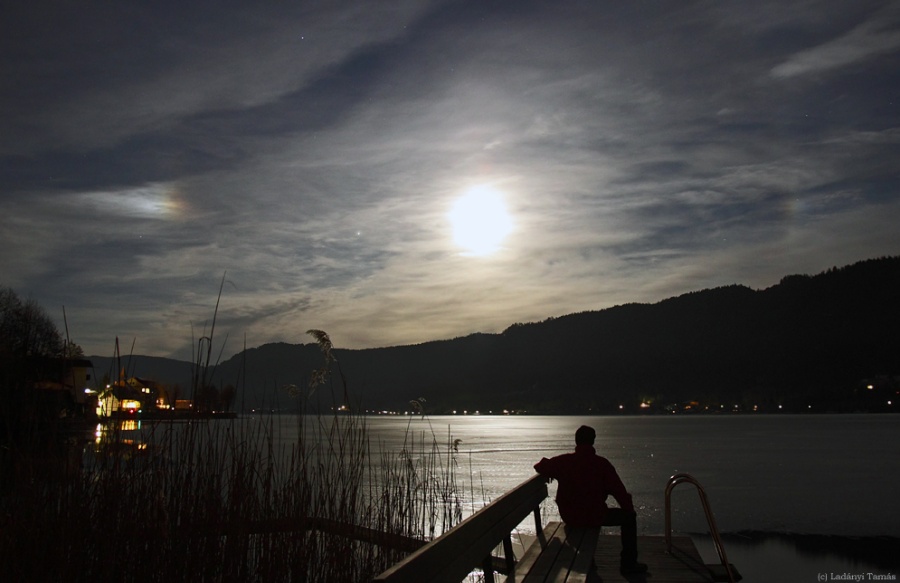
Nestled in the Austrian Alps, frozen Lake Ossiach stretches across the foreground of this serene view. Recorded on March 1, the night sky includes a nearly full Moon and bright planet Saturn seen through thin clouds near picture center. It also includes a remarkably bright and colorful moondog or paraselene at the left. Analogous to a sundog or parhelion, the paraselene is produced by moonlight shining through thin, hexagonal-shaped ice crystals in high cirrus clouds. As determined by the ice crystal geometry, the Moon is 22 degrees from the lovely paraselene.