The Moon
The Moon is Earth’s only natural satellite—a rocky, cratered body about one‑quarter the diameter of Earth, orbiting at an average distance of approximately 384,400 km. It influences tides, stabilizes Earth’s axial tilt, and was formed about 4.5 billion years ago following a collision between Earth and a Mars-sized object.
Source: science.nasa.gov
APODs including "The Moon"
Calm, Crescent Moon, and Venus
21/05/2010
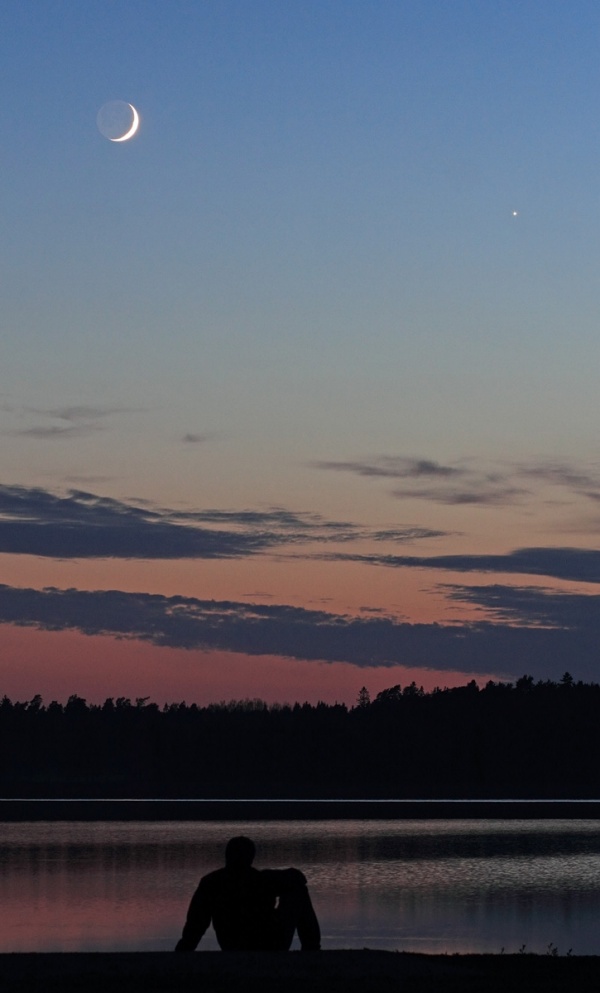
Last weekend, the Moon and Venus formed a beautiful close pair in the west after sunset, a scene enjoyed by skygazers all over the world. In this lovely view of the conjunction from Sweden, a calm lake Vallentuna lies in the foreground with sunset colors still fading behind the treeline on the far shore. The young Moon's sunlit crescent is bright, but its entire outline can be seen by Earthshine, light reflected from planet Earth itself. For well-placed skygazers, on Sunday, May 16 the Moon actually occulted (passed in front of) brilliant Venus. For many, the occultation was visible during daylight hours.