The Moon
The Moon is Earth’s only natural satellite—a rocky, cratered body about one‑quarter the diameter of Earth, orbiting at an average distance of approximately 384,400 km. It influences tides, stabilizes Earth’s axial tilt, and was formed about 4.5 billion years ago following a collision between Earth and a Mars-sized object.
Source: science.nasa.gov
APODs including "The Moon"
Moons and Rings Before Saturn
31/05/2010
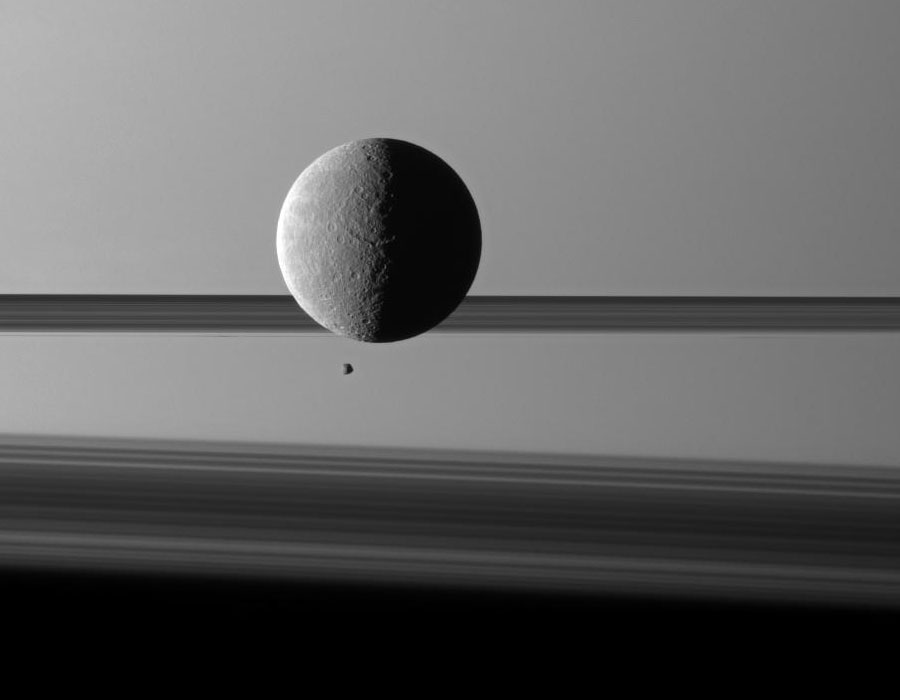
While cruising around Saturn, be on the lookout for picturesque juxtapositions of moons and rings. Another striking alignment occurred last March in the view of humanity's Saturn-orbiting Cassini spacecraft. Rhea, one of Saturn's larger moons, was caught passing Epimetheus, one of Saturn's smaller moons. Epimetheus, as pictured above, is actually well behind the heavily cratered Rhea. Further back, several of the complex rings of Saturn can be seen crossing the image horizontally. Behind both the moons and rings is giant Saturn itself, showing expansive but featureless clouds in the green light where the above image was taken. The Cassini mission around Saturn has now been extended to 2017 to better study the complex planetary system as its season changes from equinox to solstice.