The Moon
The Moon is Earth’s only natural satellite—a rocky, cratered body about one‑quarter the diameter of Earth, orbiting at an average distance of approximately 384,400 km. It influences tides, stabilizes Earth’s axial tilt, and was formed about 4.5 billion years ago following a collision between Earth and a Mars-sized object.
Source: science.nasa.gov
APODs including "The Moon"
Ecliptic New Zealand
10/07/2010
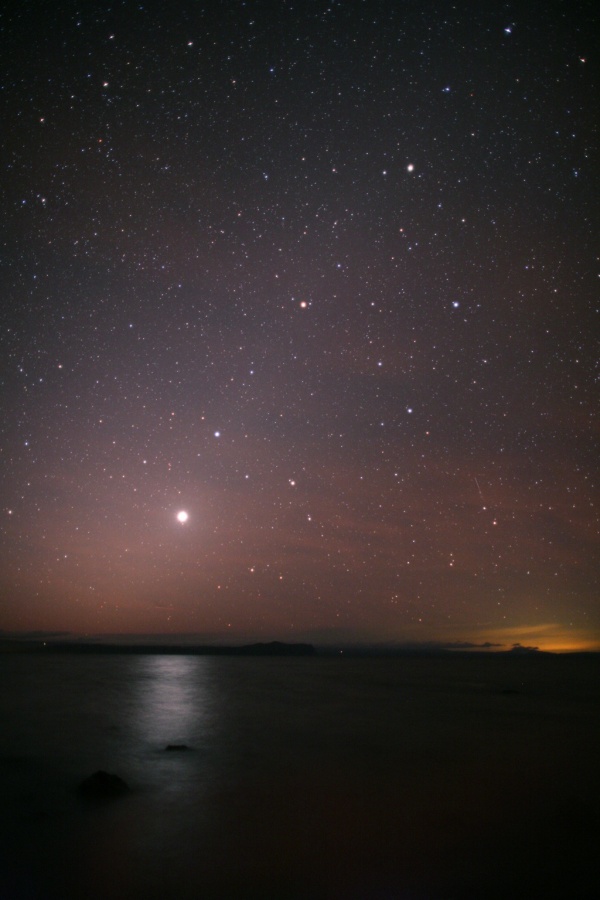
Four bright celestial beacons and a faint triangle of light follow the plane of the ecliptic as it arcs high through this southern hemisphere night skyscape. Seen on a July winter night from Lake Taupo on New Zealand's North Island, the line-up features Venus, Regulus (alpha star of Leo), Mars, and Saturn from lower left to upper right. Just put your cursor over the picture to identify the planets and constellations. The delicate luminous glow of Zodiacal Light, sunlight scattered by dust along the ecliptic, also rises above the horizon from the lower left. Of course, defined by the path of the Sun through planet Earth's sky, the ecliptic plane rides low during July nights in the northern hemisphere's summer skies. Tomorrow, the Moon and Sun will meet on the ecliptic. Along a track across the southern Pacific Ocean, the daytime sky will feature a total solar eclipse. Total Solar Eclipse: Times and Visibility | Webcast