The Moon
The Moon is Earth’s only natural satellite—a rocky, cratered body about one‑quarter the diameter of Earth, orbiting at an average distance of approximately 384,400 km. It influences tides, stabilizes Earth’s axial tilt, and was formed about 4.5 billion years ago following a collision between Earth and a Mars-sized object.
Source: science.nasa.gov
APODs including "The Moon"
Aurora Over Alaska
06/10/2010
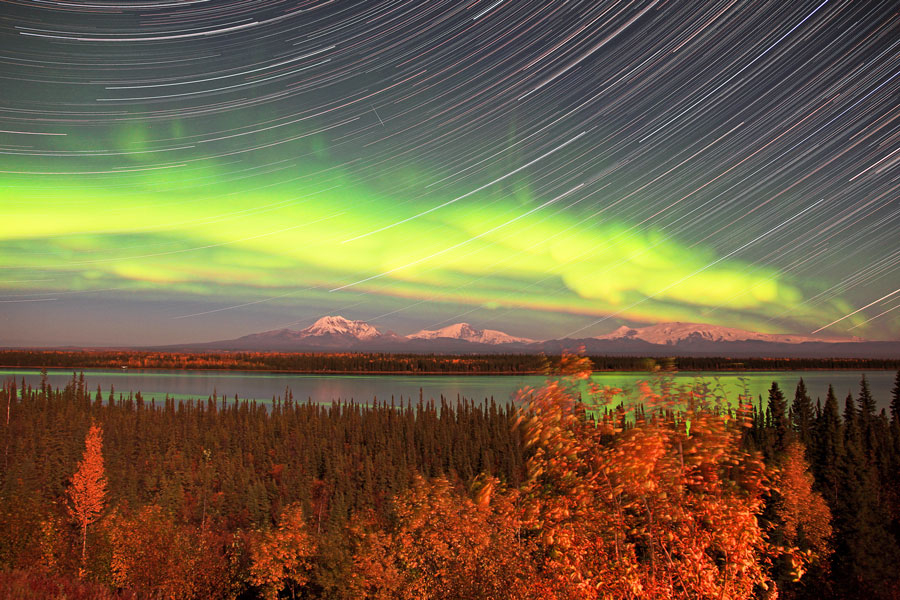
Are those green clouds or aurora? Photographed above two weeks ago, puffy green aurora help the Moon illuminate the serene Willow Lake and the snowy Wrangell and Saint Elias Mountains in eastern Alaska, USA. Although auroras might first appear to be moonlit clouds, they only add light to the sky and do not block background stars from view. Called northern lights in the northern hemisphere, auroras are caused by collisions between charged particles from the magnetosphere and air molecules high in the Earth's atmosphere. If viewed from space, auroras can be seen to glow in X-ray and ultraviolet light as well. Predictable auroras likely occur a few days after a powerful magnetic event has been seen on the Sun.