The Moon
The Moon is Earth’s only natural satellite—a rocky, cratered body about one‑quarter the diameter of Earth, orbiting at an average distance of approximately 384,400 km. It influences tides, stabilizes Earth’s axial tilt, and was formed about 4.5 billion years ago following a collision between Earth and a Mars-sized object.
Source: science.nasa.gov
APODs including "The Moon"
Moonrise Through Mauna Kea's Shadow
05/12/2010
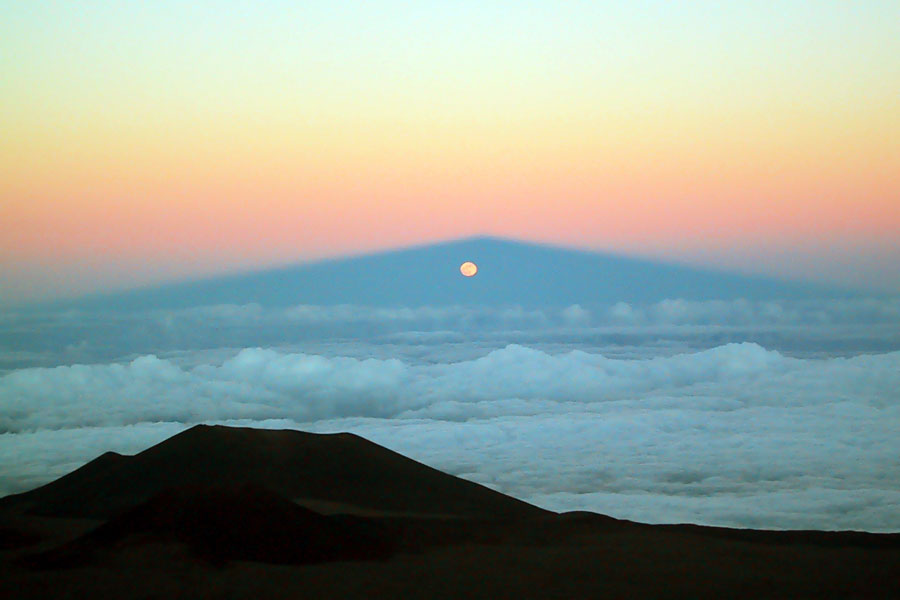
How can the Moon rise through a mountain? It cannot -- what was photographed here is a moonrise through the shadow of a large volcano. The volcano is Mauna Kea, Hawai'i, USA, a frequent spot for spectacular photographs since it is arguably the premier observing location on planet Earth. The Sun has just set in the opposite direction, behind the camera. Additionally, the Moon has just passed full phase -- were it precisely at full phase it would rise, possibly eclipsed, at the very peak of the shadow. Refraction of moonlight through the Earth's atmosphere makes the Moon appear slightly oval. Cinder cones from old volcanic eruptions are visible in the foreground. Cloud tops below Mauna Kea's summit have unusually flat tops, indicating a decrease in air moisture that frequently keeps the air unusually dry, another attribute of this stellar observing site.