The Moon
The Moon is Earth’s only natural satellite—a rocky, cratered body about one‑quarter the diameter of Earth, orbiting at an average distance of approximately 384,400 km. It influences tides, stabilizes Earth’s axial tilt, and was formed about 4.5 billion years ago following a collision between Earth and a Mars-sized object.
Source: science.nasa.gov
APODs including "The Moon"
Eclipse at Moonset
29/12/2010
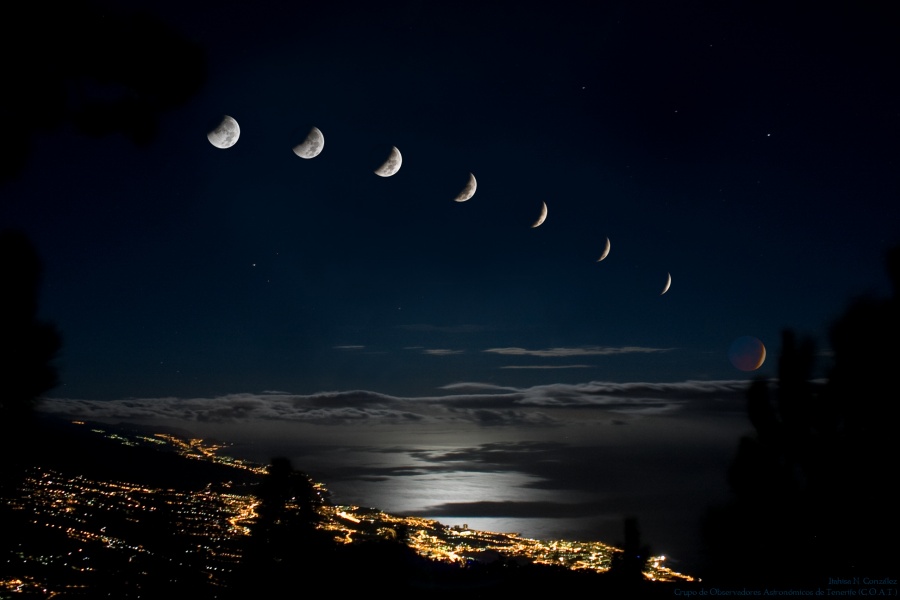
Hugging the horizon, a dark red Moon greeted early morning skygazers in eastern Atlantic regions on December 21, as the total phase of 2010's Solstice Lunar Eclipse began near moonset. This well composed image of the geocentric celestial event is a composite of multiple exposures following the progression of the eclipse from Tenerife, Canary Islands. Initially reflecting brightly on a sea of clouds and the ocean's surface itself, the Moon sinks deeper into eclipse as it moves from left to right across the sky. Opposite the Sun, the Moon was immersed in the darkest part of Earth's shadow as it approached the western horizon, just before sunrise came to Tenerife.