The Moon
The Moon is Earth’s only natural satellite—a rocky, cratered body about one‑quarter the diameter of Earth, orbiting at an average distance of approximately 384,400 km. It influences tides, stabilizes Earth’s axial tilt, and was formed about 4.5 billion years ago following a collision between Earth and a Mars-sized object.
Source: science.nasa.gov
APODs including "The Moon"
It's Raining on Titan
01/04/2011
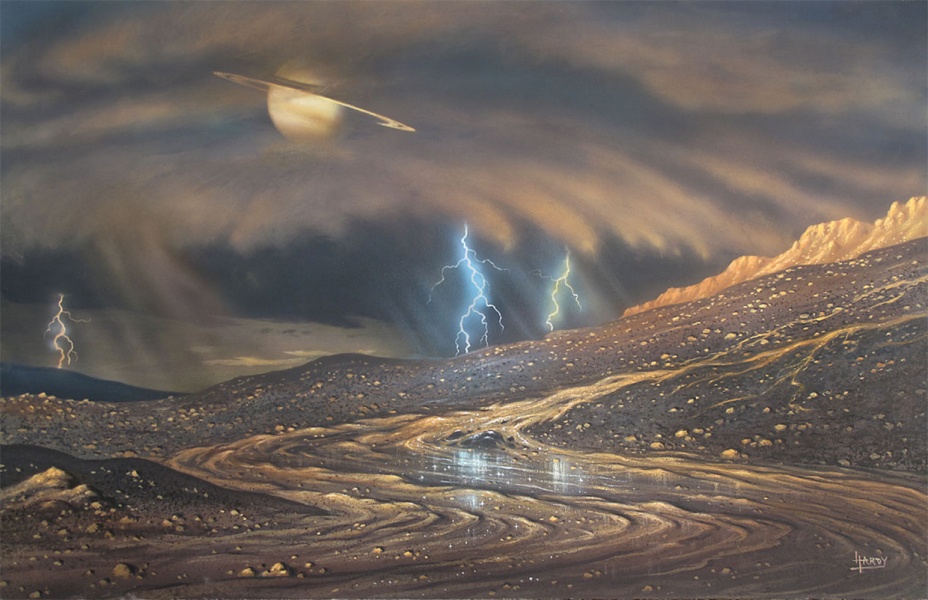
It's been raining on Titan. In fact, it's likely been raining methane on Titan and that's not an April Fools' joke. The almost familiar scene depicted in this artist's vision of the surface of Saturn's largest moon looks across an eroding landscape into a stormy sky. That scenario is consistent with seasonal rain storms temporarily darkening Titan's surface along the moon's equatorial regions, as seen by instruments onboard the Cassini spacecraft. Of course on frigid Titan, with surface temperatures of about -290 degrees F (-180 degrees C), the cycle of evaporation, cloud formation, and rain involves liquid methane instead of water. Lightning could also be possible in Titan's thick, nitrogen-rich atmosphere.