The Moon
The Moon is Earth’s only natural satellite—a rocky, cratered body about one‑quarter the diameter of Earth, orbiting at an average distance of approximately 384,400 km. It influences tides, stabilizes Earth’s axial tilt, and was formed about 4.5 billion years ago following a collision between Earth and a Mars-sized object.
Source: science.nasa.gov
APODs including "The Moon"
Eclipsed Moon in the Milky Way
17/06/2011
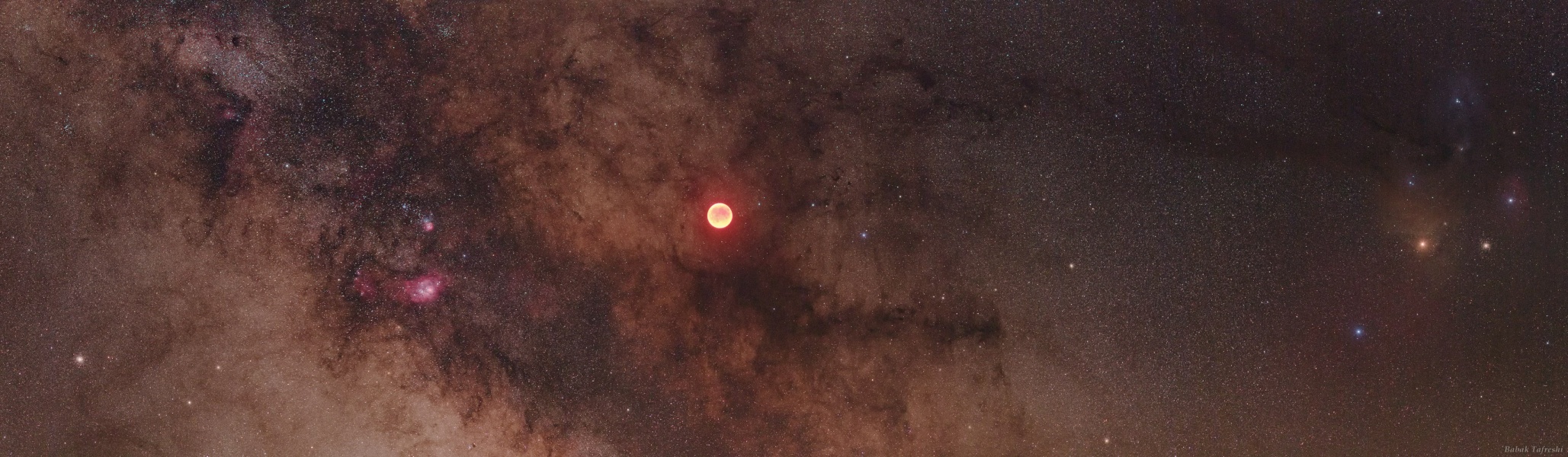
On June 15, the totally eclipsed Moon was very dark, with the Moon itself positioned on the sky toward the center of our Milky Way Galaxy. This simple panorama captures totality from northern Iran in 8 consecutive exposures each 40 seconds long. In the evocative scene, the dark of the eclipsed Moon competes with the Milky Way's faint glow. The tantalizing red lunar disk lies just above the bowl of the dark Pipe Nebula, to the right of the glowing Lagoon and Trifid nebulae and the central Milky Way dust clouds. At the far right, the wide field is anchored by yellow Antares and the colorful clouds of Rho Ophiuchi. To identify other sights of the central Milky Way just slide your cursor over the image. The total phase of this first lunar eclipse of 2011 lasted an impressive 100 minutes. Parts of the eclipse were visible from most of planet Earth, with notable exceptions of North and Central America.