The Moon
The Moon is Earth’s only natural satellite—a rocky, cratered body about one‑quarter the diameter of Earth, orbiting at an average distance of approximately 384,400 km. It influences tides, stabilizes Earth’s axial tilt, and was formed about 4.5 billion years ago following a collision between Earth and a Mars-sized object.
Source: science.nasa.gov
APODs including "The Moon"
Eclipse over the Acropolis
25/06/2011
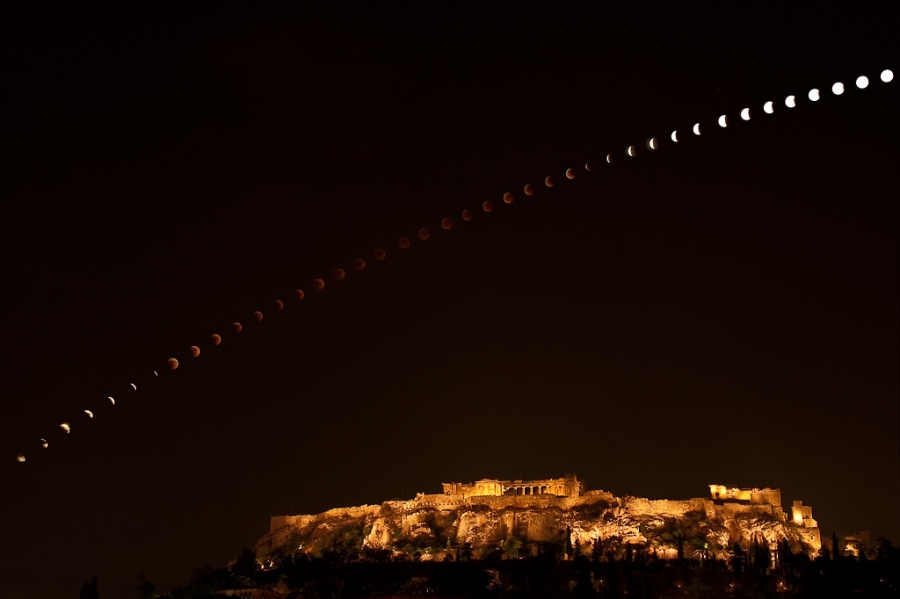
The total phase of the June 15 lunar eclipse lasted an impressive 100 minutes. Its entire duration is covered in this composite of a regular sequence of digital camera exposures, tracking the dark lunar disk as it arced above the Acropolis in Athens, Greece. In fact, around 270 BCE Greek astronomer Aristarchus also tracked the duration of lunar eclipses, though without the benefit of digital clocks and cameras. Still, using geometry, he devised a simple and impressively accurate way to calculate the Moon's distance, in terms of the radius of planet Earth, from the eclipse duration. A more modern Greek astronomer, Elias Politis titled this eclipse duration study and the accompanying youtube timelapse video "Acropoclipse". What was that?: Help identify a mystery flash seen on Mauna Kea