The Moon
The Moon is Earth’s only natural satellite—a rocky, cratered body about one‑quarter the diameter of Earth, orbiting at an average distance of approximately 384,400 km. It influences tides, stabilizes Earth’s axial tilt, and was formed about 4.5 billion years ago following a collision between Earth and a Mars-sized object.
Source: science.nasa.gov
APODs including "The Moon"
Aurora Over Greenland
23/08/2011
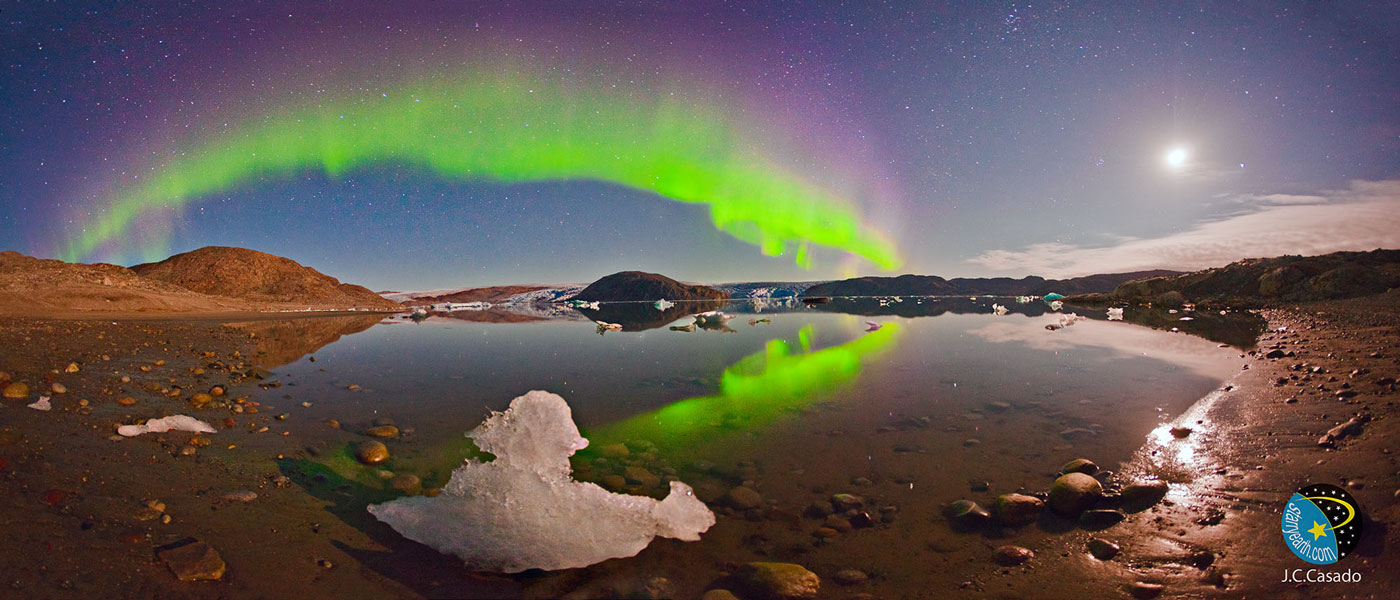
This aurora arched from horizon to horizon. During the current Shelios expedition to observe and learn about the northern lights, the sky last weekend did not disappoint. After sunset and some careful photographic planning, the above image was taken from the expedition's Qaleraliq campsite in southern Greenland. Visible straight through the center of the aurora, found with a careful eye, is the Big Dipper and the surrounding constellation of the Big Bear (Ursa Major). The brightest orb on the far right is the Moon, while Jupiter can be seen even further to the right. The Shelios expedition is scheduled to last until the end of August and include live broadcasts of ongoing auroras.