The Moon
The Moon is Earth’s only natural satellite—a rocky, cratered body about one‑quarter the diameter of Earth, orbiting at an average distance of approximately 384,400 km. It influences tides, stabilizes Earth’s axial tilt, and was formed about 4.5 billion years ago following a collision between Earth and a Mars-sized object.
Source: science.nasa.gov
APODs including "The Moon"
A February Moon's Halo
11/02/2012
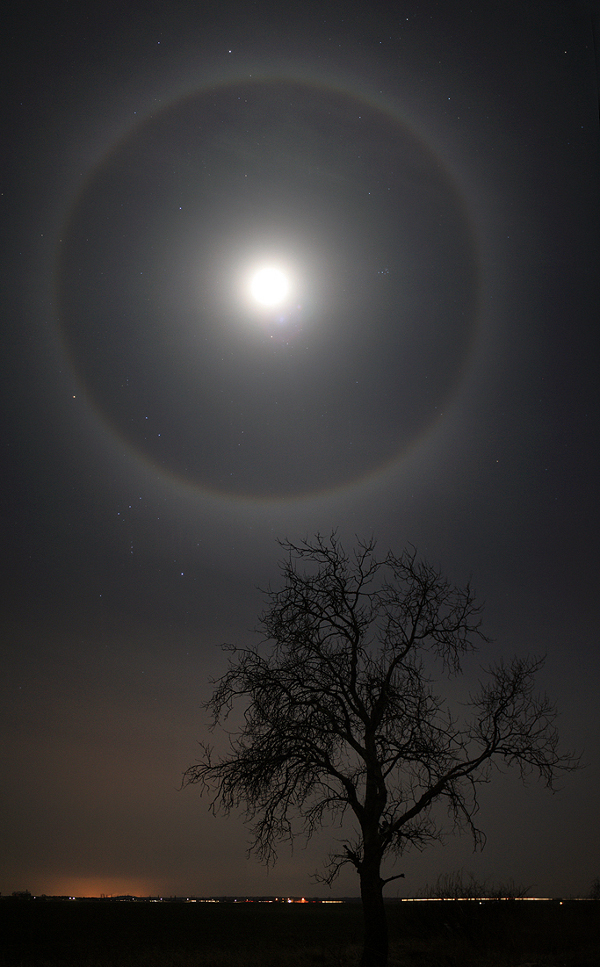
Lighting the night last Tuesday, February's Full Moon is sometimes called the Snow Moon. But the Moon was not quite full in this mosaicked skyscape recorded on February 2 south of Budapest, Hungary, and there was no snow either. Still, thin clouds of ice crystals hung in the cold, wintry sky creating this gorgeous lunar halo. Refraction of moonlight by the six-sided crystals produce the slightly colored halo with its characteristic radius of 22 degrees. Just below the Moon is bright star Aldebaran. Also well within the halo at the right is the Pleiades star cluster. At the lower left, near the halo's edge lie the stars of Orion with bright Capella, alpha star of the constellation Auriga, just beyond the halo near the top of the frame.