The Moon
The Moon is Earth’s only natural satellite—a rocky, cratered body about one‑quarter the diameter of Earth, orbiting at an average distance of approximately 384,400 km. It influences tides, stabilizes Earth’s axial tilt, and was formed about 4.5 billion years ago following a collision between Earth and a Mars-sized object.
Source: science.nasa.gov
APODs including "The Moon"
Lick Observatory Moonrise
10/03/2012
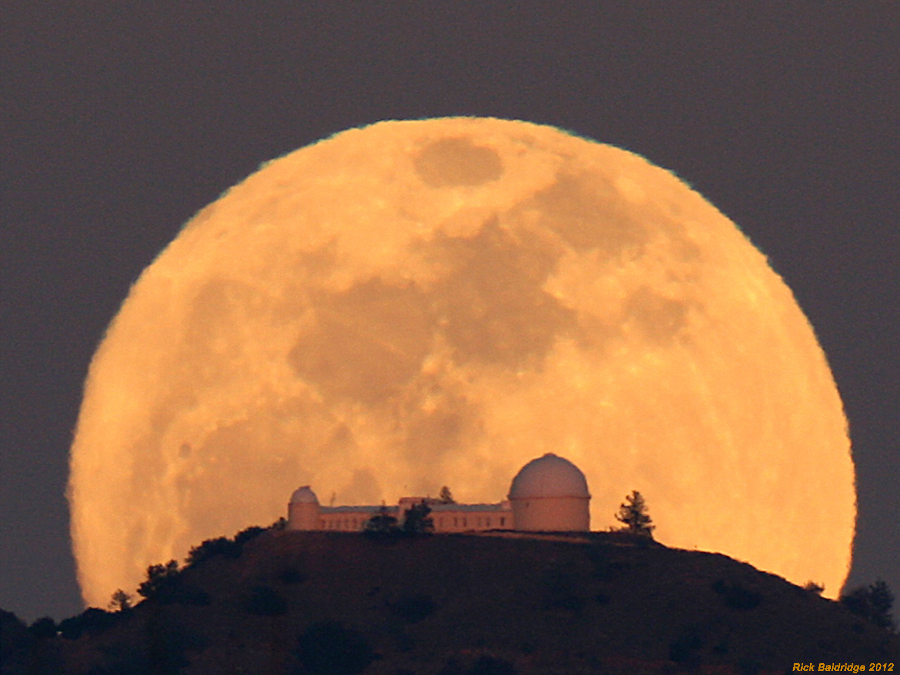
As viewed from a well chosen location at sunset, the gorgeous Full Moon rose behind Mount Hamilton, east of San Jose, California on March 7. The lunar disk frames historic Lick Observatory perched on the mountain's 4,200 foot summit. Both observatory and Moon echo the warm color of sunlight (moonlight is reflected sunlight) filtered by a long path through the atmosphere. Substantial atmospheric refraction contributes the Moon's ragged, green rim. Of course, the March Full Moon is also known as the Full Worm Moon. In the telescopic photo, Lick's 40 inch Nickel Telescope dome is on the left. The large dome on the right houses Lick's Great 36 inch Refractor.