The Moon
The Moon is Earth’s only natural satellite—a rocky, cratered body about one‑quarter the diameter of Earth, orbiting at an average distance of approximately 384,400 km. It influences tides, stabilizes Earth’s axial tilt, and was formed about 4.5 billion years ago following a collision between Earth and a Mars-sized object.
Source: science.nasa.gov
APODs including "The Moon"
The Grand Canyon in Moonlight
30/03/2012
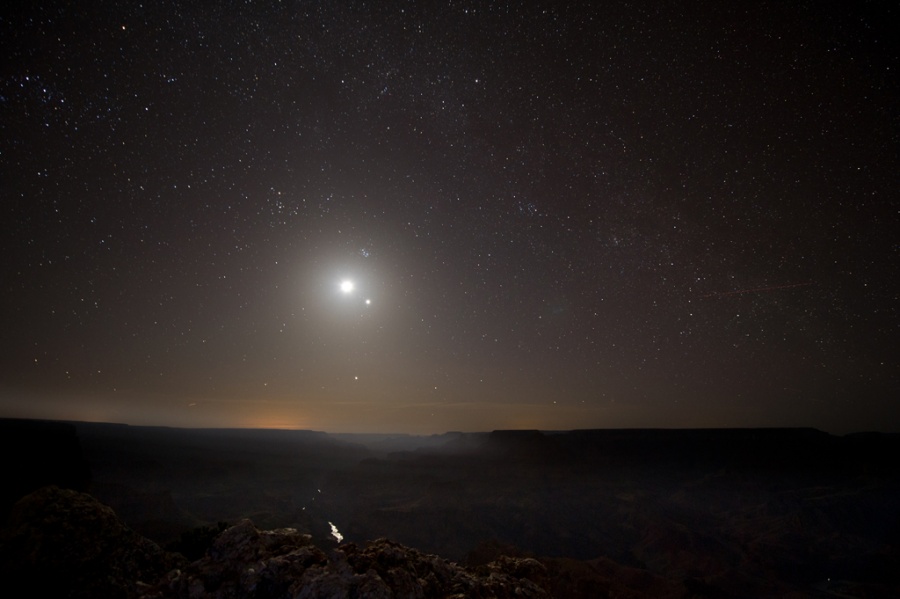
In this alluring night skyscape recorded on March 26, a young Moon stands over the distant western horizon in conjunction with brilliant planet Venus. In the foreground, the Colorado River glistens in moonlight as it winds through the Grand Canyon, seen from the canyon's southern rim at Lipan Point. Of course, the Grand Canyon is known as one of the wonders of planet Earth. Carved by the river, the enormous fissure is about 270 miles (440 kilometers) long, up to 18 miles (30 kilometers) wide and approaches 1 mile (1.6 kilometers) deep. On this date, wonders of the night sky included the compact Pleiades and V-shaped Hyades star clusters poised just above the Moon. Bright planet Jupiter is below the closer Moon/Venus pairing, near the western horizon.