The Moon
The Moon is Earth’s only natural satellite—a rocky, cratered body about one‑quarter the diameter of Earth, orbiting at an average distance of approximately 384,400 km. It influences tides, stabilizes Earth’s axial tilt, and was formed about 4.5 billion years ago following a collision between Earth and a Mars-sized object.
Source: science.nasa.gov
APODs including "The Moon"
A Partial Eclipse Over Manila Bay
20/05/2012
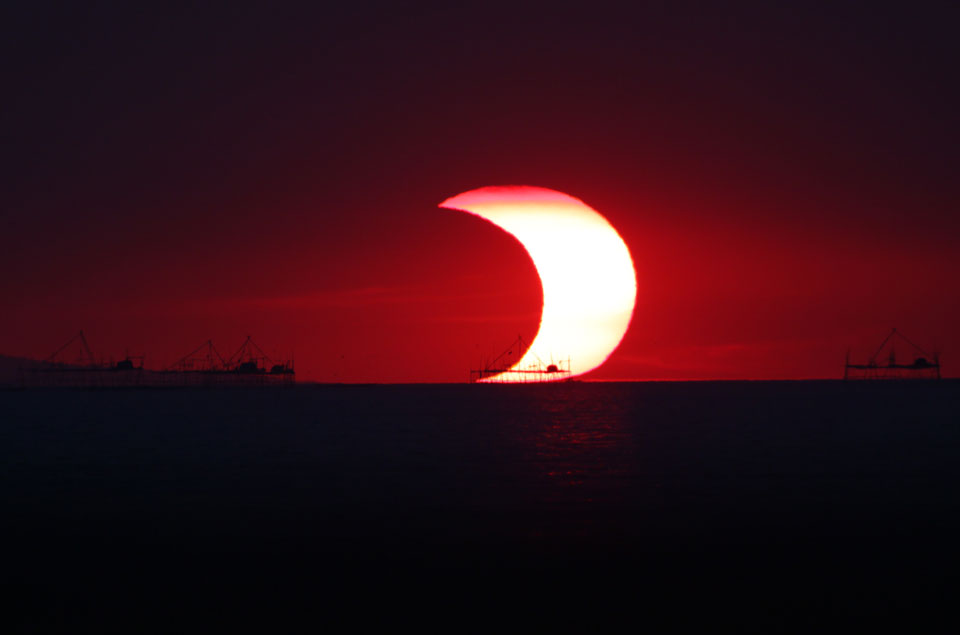
What's happened to the setting Sun? An eclipse! In early 2009, the Moon eclipsed part of the Sun as visible from parts of Africa, Australia, and Asia. In particular the above image, taken from the Mall of Asia seawall, caught a partially eclipsed Sun setting over Manila Bay in the Philippines. Piers are visible in silhouette in the foreground. Eclipse chasers and well placed sky enthusiasts captured many other interesting and artistic images of the year's only annular solar eclipse, including movies, eclipse shadow arrays, and rings of fire. Today parts of the Sun again will become briefly blocked by the Moon, again visible to some as a partial eclipse of a setting Sun. A small swath of Earth, however, will be exposed to the unusual ring of fire effect when the Moon is completely surrounded by the glowing light of the slightly larger Sun. APOD Collection: Images of Past Partial Solar Eclipses Gallery: Images of Today's Eclipse