The Moon
The Moon is Earth’s only natural satellite—a rocky, cratered body about one‑quarter the diameter of Earth, orbiting at an average distance of approximately 384,400 km. It influences tides, stabilizes Earth’s axial tilt, and was formed about 4.5 billion years ago following a collision between Earth and a Mars-sized object.
Source: science.nasa.gov
APODs including "The Moon"
A Solar Eclipse Quilt
13/11/2012
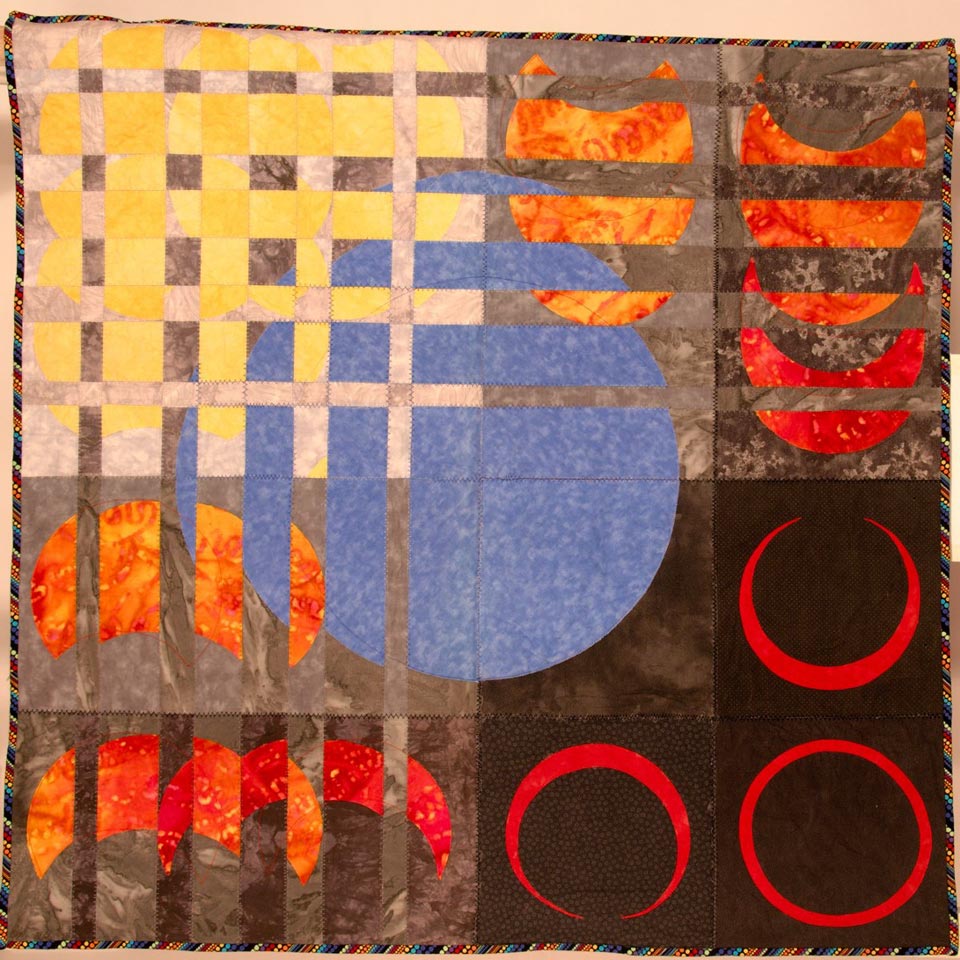
Some people are so inspired by solar eclipses that they quilt. Pictured above is a resulting textile from one such inspiration. The 38x38 inch quilt offers impressions of a total annular eclipse, when the Moon is too far from the Earth to cover the entire Sun, witnessed in Spain in October of 2005. Today, however, a full total solar eclipse will occur, although it will only be visible to eclipse chasers and those who live in a thin swath of Australia. For a few minutes, those near the center of the eclipse path will see the entire Sun blocked by the Moon, causing the day to become unusually dark. Just before -- and just after -- totality occurs, sunlight may stream between mountains on the Moon's edge creating a diamond ring effect. The next total eclipse of the Sun will occur in November 2013.