The Moon
The Moon is Earth’s only natural satellite—a rocky, cratered body about one‑quarter the diameter of Earth, orbiting at an average distance of approximately 384,400 km. It influences tides, stabilizes Earth’s axial tilt, and was formed about 4.5 billion years ago following a collision between Earth and a Mars-sized object.
Source: science.nasa.gov
APODs including "The Moon"
Alaskan Moondogs
26/01/2013
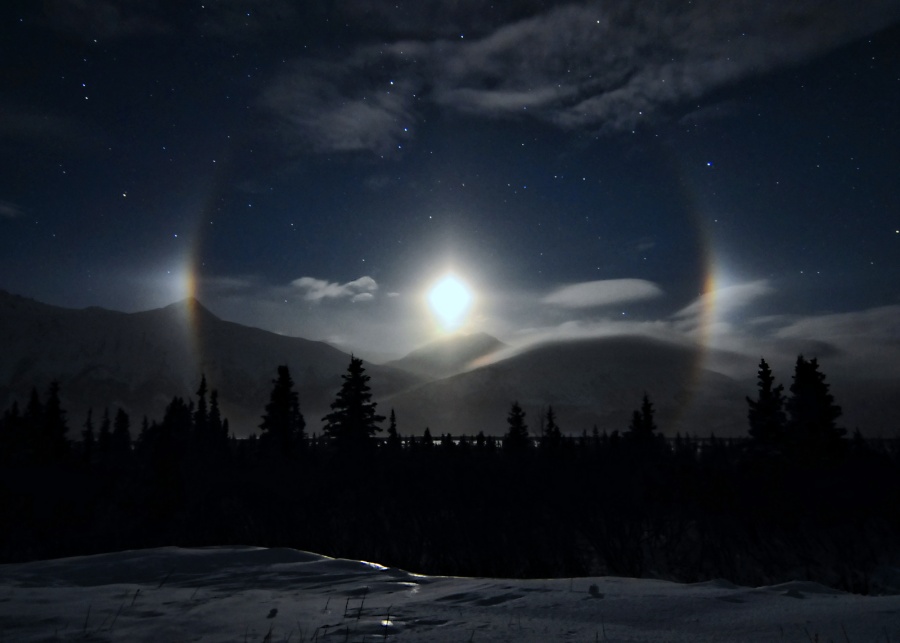
Moonlight illuminates a snowy scene in this night land and skyscape made on January 17 from Lower Miller Creek, Alaska, USA. Overexposed near the mountainous western horizon is the first quarter Moon itself, surrounded by an icy halo and flanked left and right by moondogs. Sometimes called mock moons, a more scientific name for the luminous apparitions is paraselenae (plural). Analogous to a sundog or parhelion, a paraselene is produced by moonlight refracted through thin, hexagonal, plate-shaped ice crystals in high cirrus clouds. As determined by the crystal geometry, paraselenae are seen at an angle of 22 degrees or more from the Moon. Compared to the bright lunar disk, paraselenae are faint and easier to spot when the Moon is low.