The Moon
The Moon is Earth’s only natural satellite—a rocky, cratered body about one‑quarter the diameter of Earth, orbiting at an average distance of approximately 384,400 km. It influences tides, stabilizes Earth’s axial tilt, and was formed about 4.5 billion years ago following a collision between Earth and a Mars-sized object.
Source: science.nasa.gov
APODs including "The Moon"
GRAIL Maps the Moon's Gravity
19/03/2013
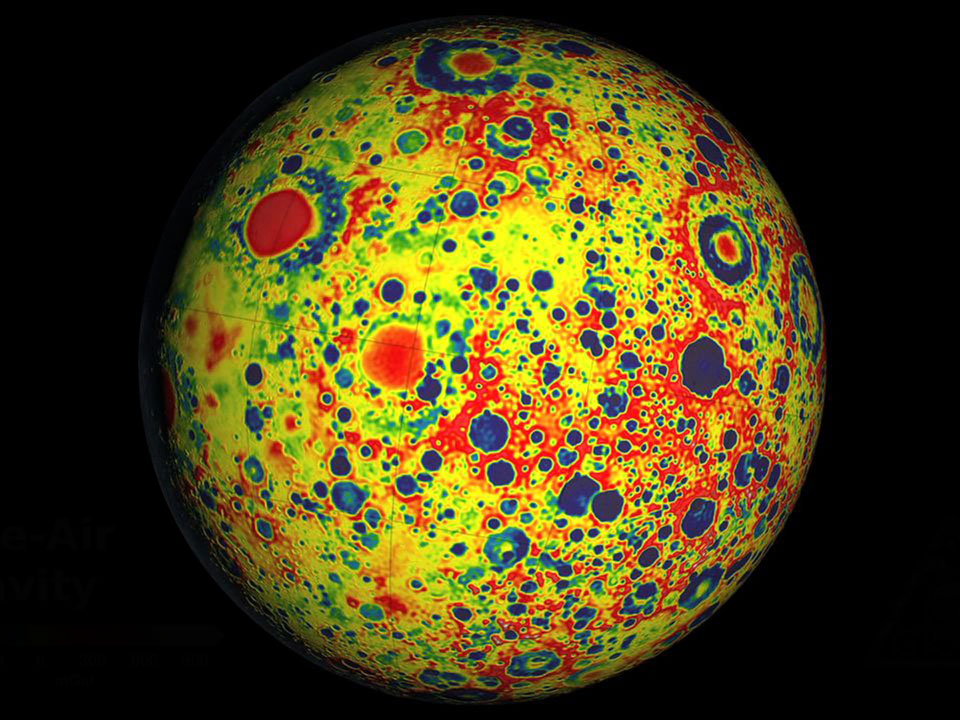
How did the Moon form? To help find out, NASA launched the twin Gravity Recovery and Interior Laboratory (GRAIL) satellites in 2011 to orbit and map the Moon's surface gravity in unprecedented detail. Pictured above is a resulting GRAIL gravity map, with regions of slightly lighter gravity shown in blue and regions of slightly stronger gravity shown in red. Analysis of GRAIL data indicates that the moon has an unexpectedly shallow crust than runs about 40 kilometers deep, and an overall composition similar to the Earth. Although other surprising structures have been discovered that will continue to be investigated, the results generally bolster the hypothesis that the Moon formed mostly from Earth material following a tremendous collision in the early years of our Solar System, about 4.5 billion years ago. After completing their mission and running low on fuel, the two GRAIL satellites, Ebb and Flow, were crashed into a lunar mountain at about 6,000 kilometer per hour. Growing Gallery: Comet PanSTARRS at Sunset