The Moon
The Moon is Earth’s only natural satellite—a rocky, cratered body about one‑quarter the diameter of Earth, orbiting at an average distance of approximately 384,400 km. It influences tides, stabilizes Earth’s axial tilt, and was formed about 4.5 billion years ago following a collision between Earth and a Mars-sized object.
Source: science.nasa.gov
APODs including "The Moon"
Crescent Moon Meets Evening Star
13/09/2013
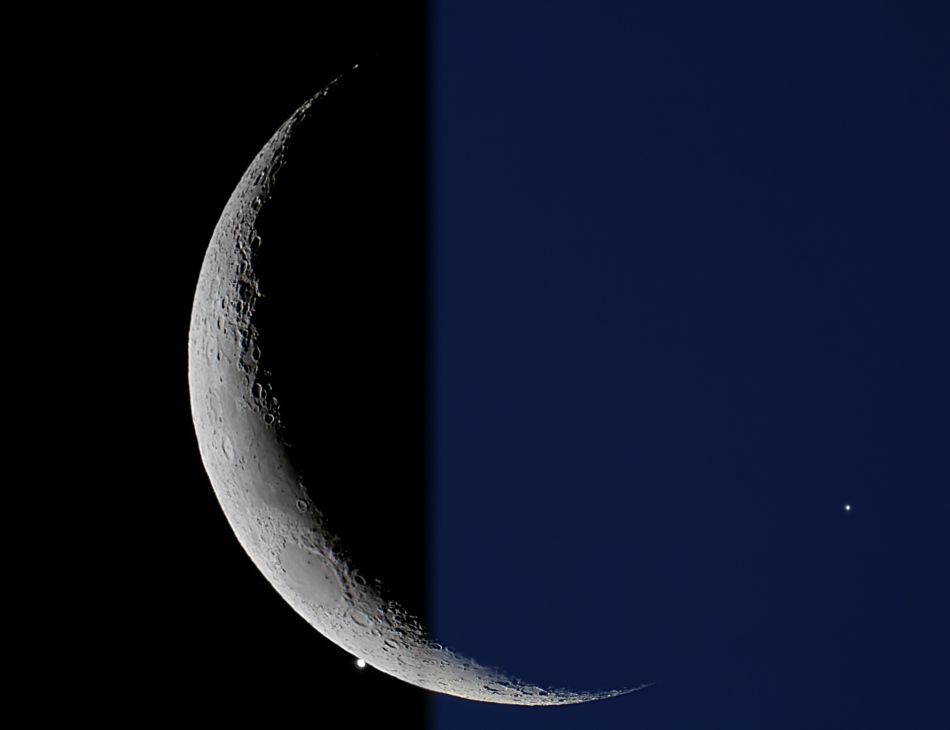
On September 8, brilliant planet Venus appearing as the evening star stood near a slender, crescent Moon at sunset. The close celestial pairing or conjunction was a scene enjoyed by skygazers around the world. But from some locations in South America, the Moon actually passed in front of Venus in a lunar occultation. Captured near Las Cañas, Uruguay, this two frame mosaic telescopic view shows the Moon and Venus before and after the occultation. The silvery evening star appears at right just before it winked out behind the dark lunar limb, still in bright twilight skies. About an hour later Venus emerged (left) along the three day old Moon's sunlit edge.