The Moon
The Moon is Earth’s only natural satellite—a rocky, cratered body about one‑quarter the diameter of Earth, orbiting at an average distance of approximately 384,400 km. It influences tides, stabilizes Earth’s axial tilt, and was formed about 4.5 billion years ago following a collision between Earth and a Mars-sized object.
Source: science.nasa.gov
APODs including "The Moon"
Solar Eclipse from Uganda
08/11/2013
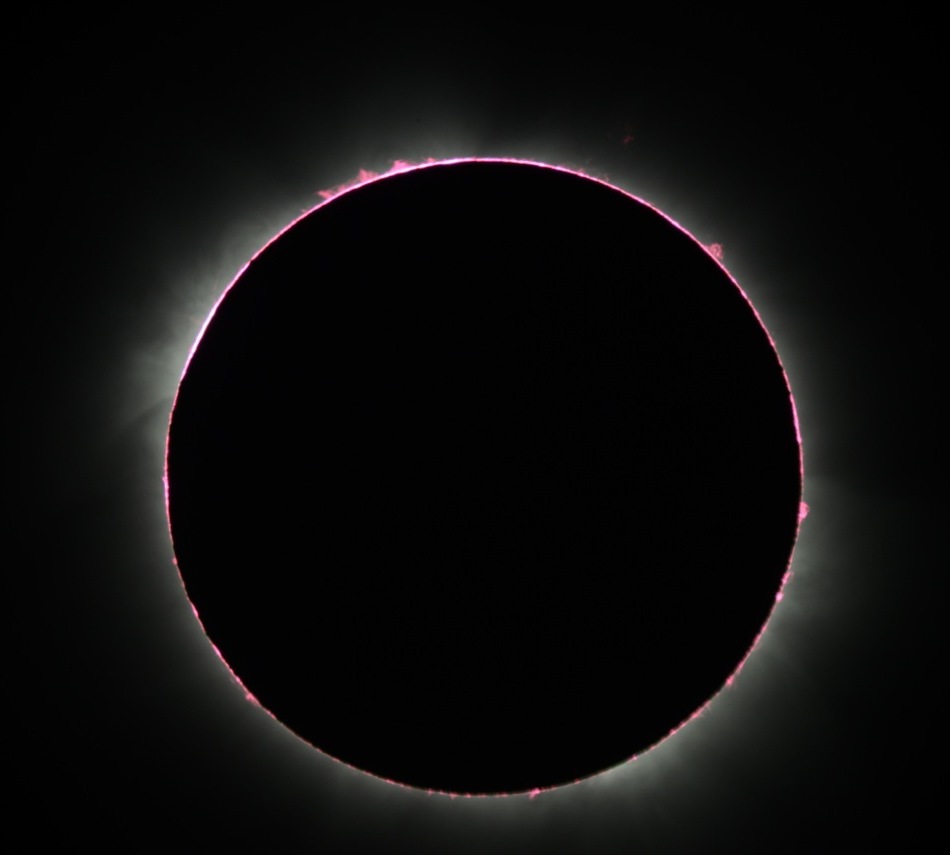
The Sun's disk was totally eclipsed for a brief 20 seconds as the Moon's dark umbral shadow raced across Pokwero in northwestern Uganda on November 3rd. So this sharp telescopic view of totality in clear skies from the central African locale was much sought after by eclipse watchers. In the inspiring celestial scene the Moon just covers the overwhelmingly bright photosphere, the lower, normally visible layer of the Sun's atmosphere. Extending beyond the photosphere, the reddish hydrogen alpha glow of the solar chromosphere outlines the lunar silhouette, fading into the Sun's tenuous, hot, outer atmosphere or corona. Planet-sized prominences reaching beyond the limb of the active Sun adorn the edges of the silhouette, including a cloud of glowing plasma separated from the chromosphere near the 1 o'clock position.