The Moon
The Moon is Earth’s only natural satellite—a rocky, cratered body about one‑quarter the diameter of Earth, orbiting at an average distance of approximately 384,400 km. It influences tides, stabilizes Earth’s axial tilt, and was formed about 4.5 billion years ago following a collision between Earth and a Mars-sized object.
Source: science.nasa.gov
APODs including "The Moon"
Möbius Arch Moonrise
28/02/2014
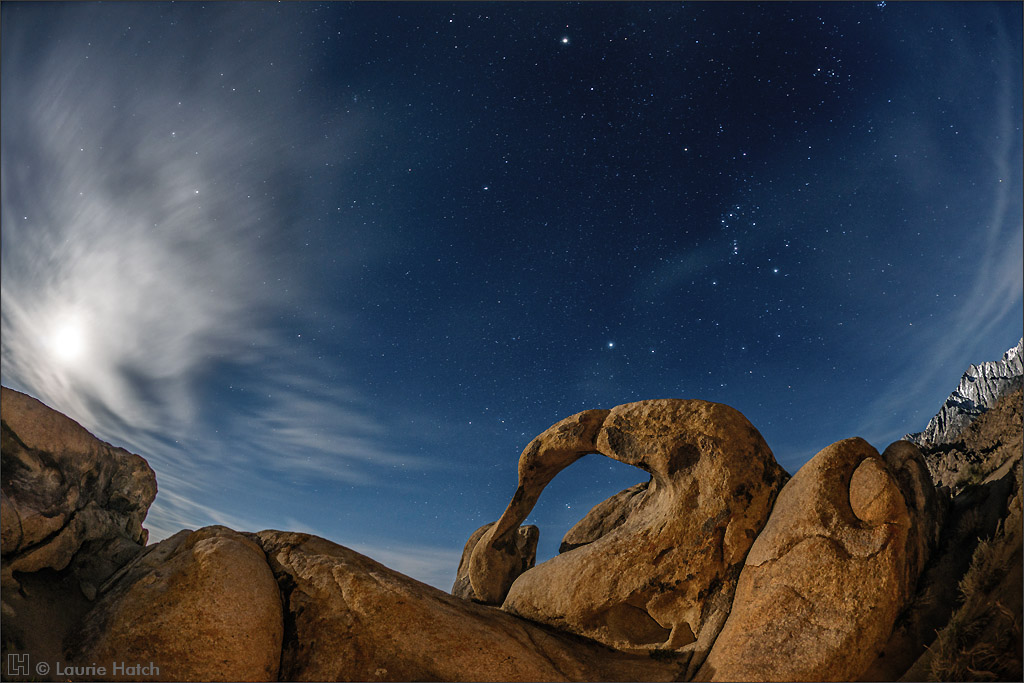
Only two days past full, February's moon shines through thin clouds, rising on the left in this fisheye night skyscape. The moonlight illuminates a weathered, rounded foreground in the Alabama Hills, conveniently located east of Mt. Whitney along the Sierra Nevada range in California, USA, planet Earth. Orion the Hunter stands at the right, a familiar northern winter constellation. Bright Jupiter, the solar system's ruling gas giant, is near center at the top of the frame. Below Jupiter, Sirius, alpha star of the Big Dog, poses above a bowed and twisted landform known as Möbius Arch, its curve reminiscent of the mathematically famous surface with only one side. Of course, instead of using rock, wind, and weather, a Möbius strip is easier to make with paper, scissors, and tape.