The Moon
The Moon is Earth’s only natural satellite—a rocky, cratered body about one‑quarter the diameter of Earth, orbiting at an average distance of approximately 384,400 km. It influences tides, stabilizes Earth’s axial tilt, and was formed about 4.5 billion years ago following a collision between Earth and a Mars-sized object.
Source: science.nasa.gov
APODs including "The Moon"
The Moon Eclipses Saturn
16/07/2014
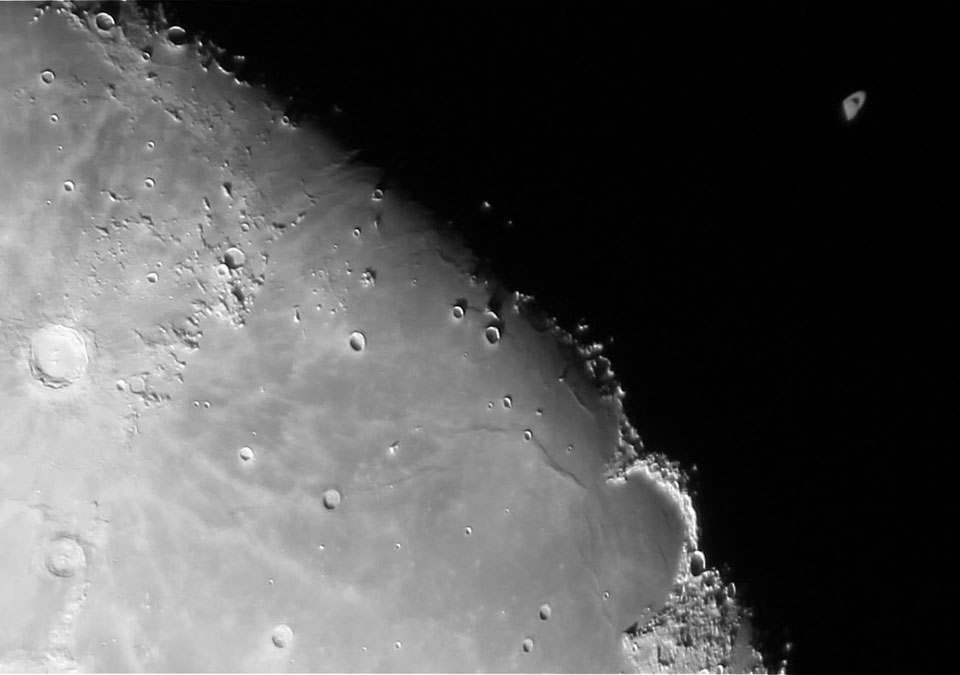
What happened to half of Saturn? Nothing other than Earth's Moon getting in the way. As pictured above on the far right, Saturn is partly eclipsed by a dark edge of a Moon itself only partly illuminated by the Sun. This year the orbits of the Moon and Saturn have led to an unusually high number of alignments of the ringed giant behind Earth's largest satellite. Technically termed an occultation, the above image captured one such photogenic juxtaposition from Buenos Aires, Argentina that occurred early last week. Visible to the unaided eye but best viewed with binoculars, there are still four more eclipses of Saturn by our Moon left in 2014. The next one will be on August 4 and visible from Australia, while the one after will occur on August 31 and be visible from western Africa at night but simultaneously from much of eastern North America during the day.