The Moon
The Moon is Earth’s only natural satellite—a rocky, cratered body about one‑quarter the diameter of Earth, orbiting at an average distance of approximately 384,400 km. It influences tides, stabilizes Earth’s axial tilt, and was formed about 4.5 billion years ago following a collision between Earth and a Mars-sized object.
Source: science.nasa.gov
APODs including "The Moon"
Eclipse at Moonset
09/10/2014
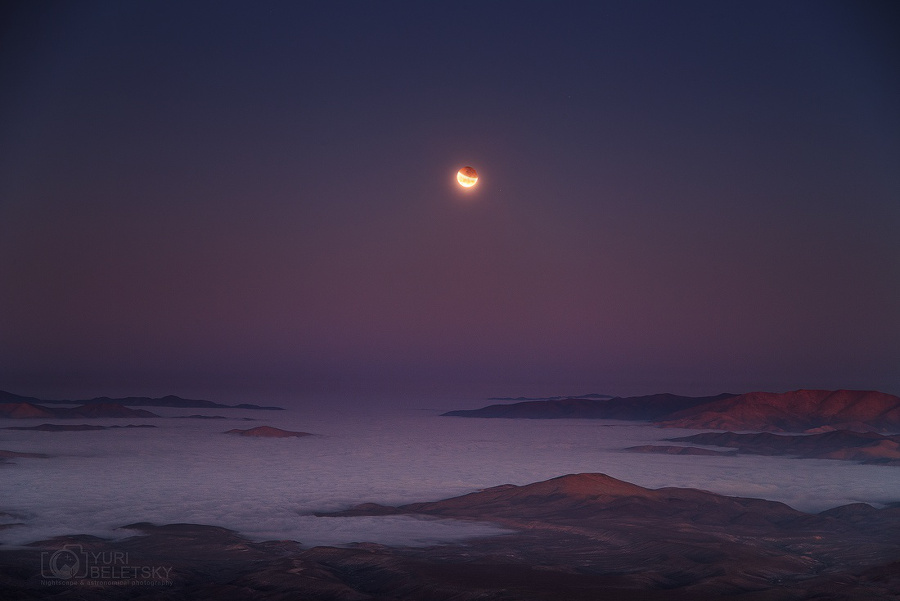
The Pacific Ocean and Chilean coast lie below this sea of clouds. Seen through the subtle colors of the predawn sky a lunar eclipse is in progress above, the partially eclipsed Moon growing dark. The curved edge of planet Earth's shadow still cuts across the middle of the lunar disk as the Moon sinks lower toward the western horizon. In fact, from this southern hemisphere location as well as much of eastern North America totality, the Moon completely immersed within Earth's shadow, began near the time of moonset and sunrise on October 8. From farther west the total phase could be followed for almost an hour though, the darker reddened Moon still high in the night sky.