The Moon
The Moon is Earth’s only natural satellite—a rocky, cratered body about one‑quarter the diameter of Earth, orbiting at an average distance of approximately 384,400 km. It influences tides, stabilizes Earth’s axial tilt, and was formed about 4.5 billion years ago following a collision between Earth and a Mars-sized object.
Source: science.nasa.gov
APODs including "The Moon"
Moon and Earth from Chang'e 5-T1
04/11/2014
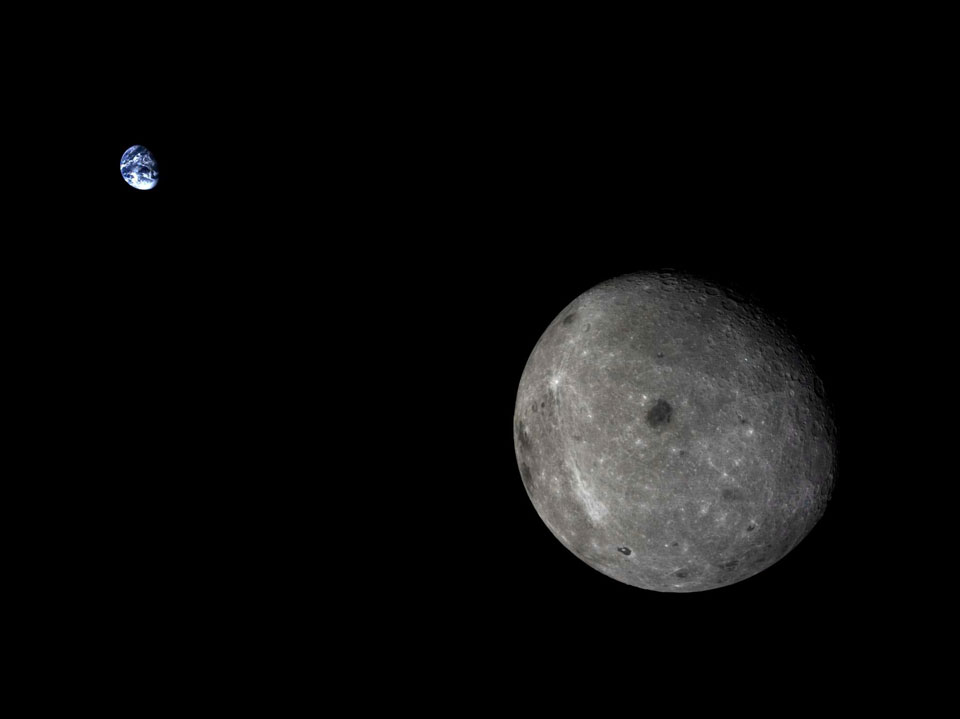
Described at times as a big blue marble, from some vantage points Earth looks more like a small blue marble. Such was the case in this iconic image of the Earth and Moon system taken by the Chang'e 5-T1 mission last week. The Moon appears larger than the Earth because it was much closer to the spacecraft's camera. Displaying much of a surface usually hidden from Earth, the Moon appears dark and gray when compared to the more reflective and colorful planet that it orbits. The robotic Chang'e 5-T1 spacecraft, predominantly on an engineering test mission, rounded the Moon last Tuesday returned to Earth on Friday.