The Moon
The Moon is Earth’s only natural satellite—a rocky, cratered body about one‑quarter the diameter of Earth, orbiting at an average distance of approximately 384,400 km. It influences tides, stabilizes Earth’s axial tilt, and was formed about 4.5 billion years ago following a collision between Earth and a Mars-sized object.
Source: science.nasa.gov
APODs including "The Moon"
Orion Launch
06/12/2014
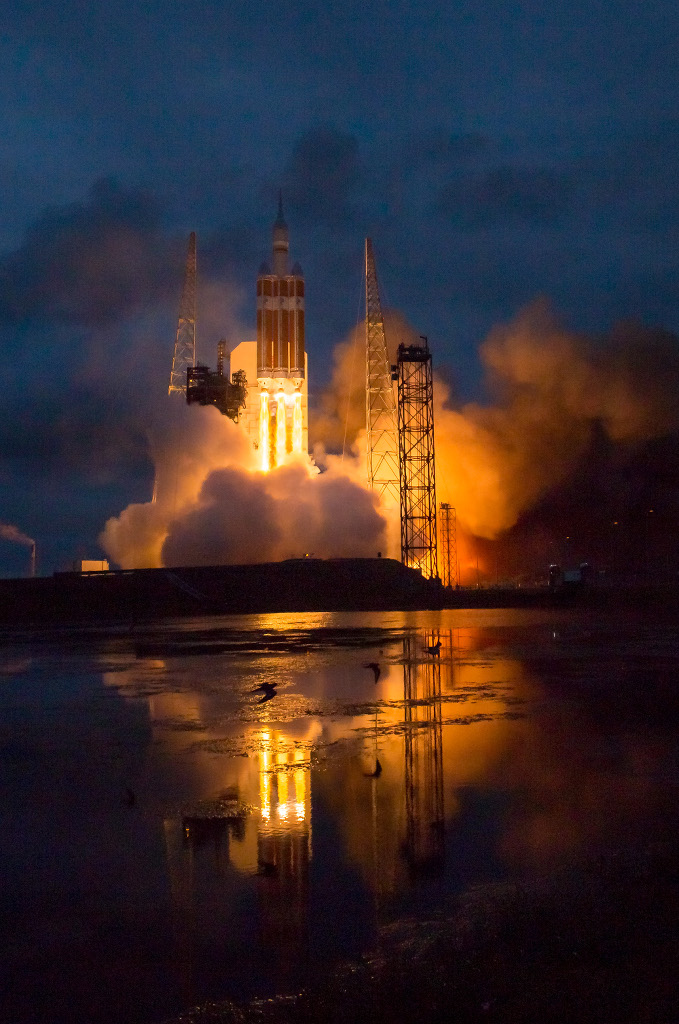
Headed for two orbits of planet Earth and a splashdown in the Pacific, Orion blazed into the early morning sky on Friday at 7:05am ET. The spacecraft was launched atop a United Launch Aliance Delta IV Heavy rocket from Cape Canaveral Air Force Station in Florida. Its first voyage into space on an uncrewed flight test, the Orion traveled some 3,600 miles from Earth, about 15 times higher than the orbital altitude of the International Space Station. In fact, Orion traveled farther into space than any spacecraft designed for astronauts since the Apollo missions to the Moon. The Orion crew module reached speeds of 20,000 miles per hour and temperatures approaching 4,000 degrees Fahrenheit as it re-entered Earth's atmosphere about 4.5 hours after launch.