The Moon
The Moon is Earth’s only natural satellite—a rocky, cratered body about one‑quarter the diameter of Earth, orbiting at an average distance of approximately 384,400 km. It influences tides, stabilizes Earth’s axial tilt, and was formed about 4.5 billion years ago following a collision between Earth and a Mars-sized object.
Source: science.nasa.gov
APODs including "The Moon"
A Double Eclipse of the Sun
22/03/2015
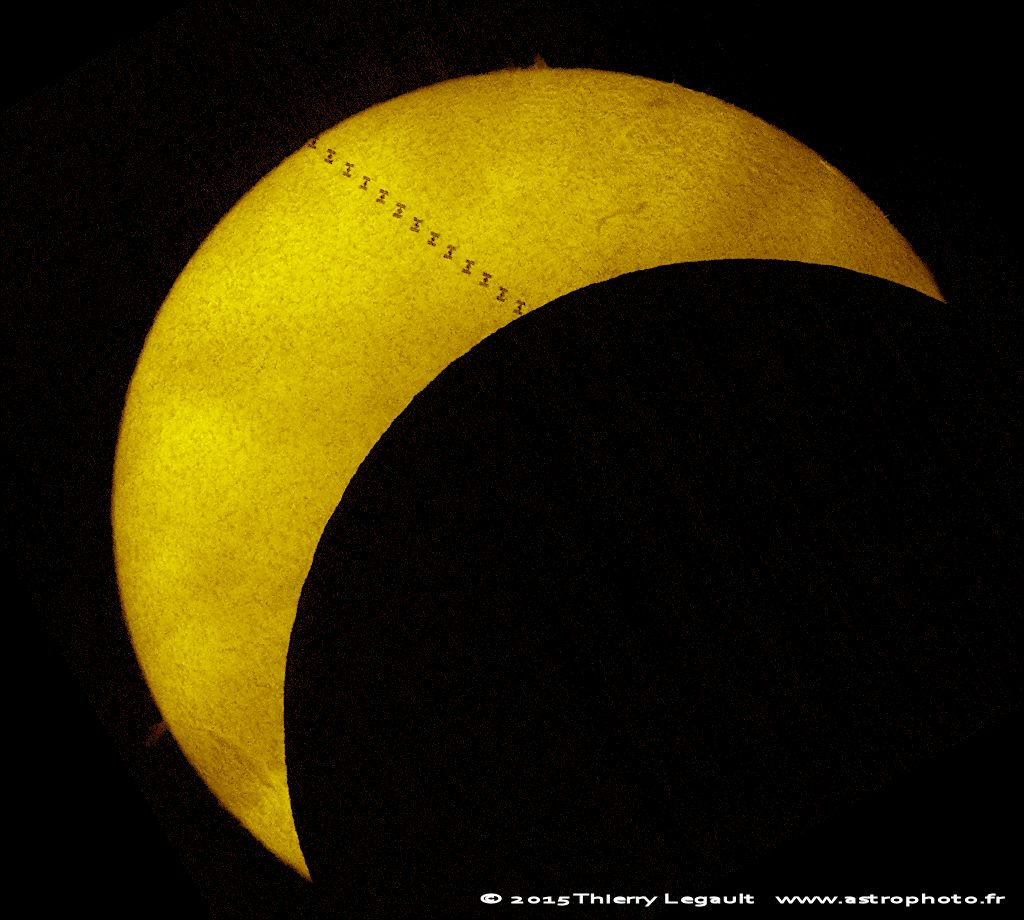
Can the Sun be eclipsed twice at the same time? Last Friday was noteworthy because part of the Earth was treated to a rare total eclipse of the Sun. But also on Friday, from a part of the Earth that only saw part of the Sun eclipsed, a second object appeared simultaneously in front of the Sun: the Earth-orbiting International Space Station. Although space station eclipses are very quick -- in this case only 0.6 seconds, they are not so rare. Capturing this composite image took a lot of planning and a little luck, as the photographer had to dodge a series of third objects that kept, annoyingly, also lining up in front of the Sun: clouds. The above superposed time-lapse sequence was taken from Fregenal de la Sierra in southern Spain. The dark disk of the Moon dominates the lower right, while the Sun's textured surface shows several filaments and, over an edge, a prominence. Gallery: Solar Eclipse