The Moon
The Moon is Earth’s only natural satellite—a rocky, cratered body about one‑quarter the diameter of Earth, orbiting at an average distance of approximately 384,400 km. It influences tides, stabilizes Earth’s axial tilt, and was formed about 4.5 billion years ago following a collision between Earth and a Mars-sized object.
Source: science.nasa.gov
APODs including "The Moon"
ISS Double Transit
12/09/2015
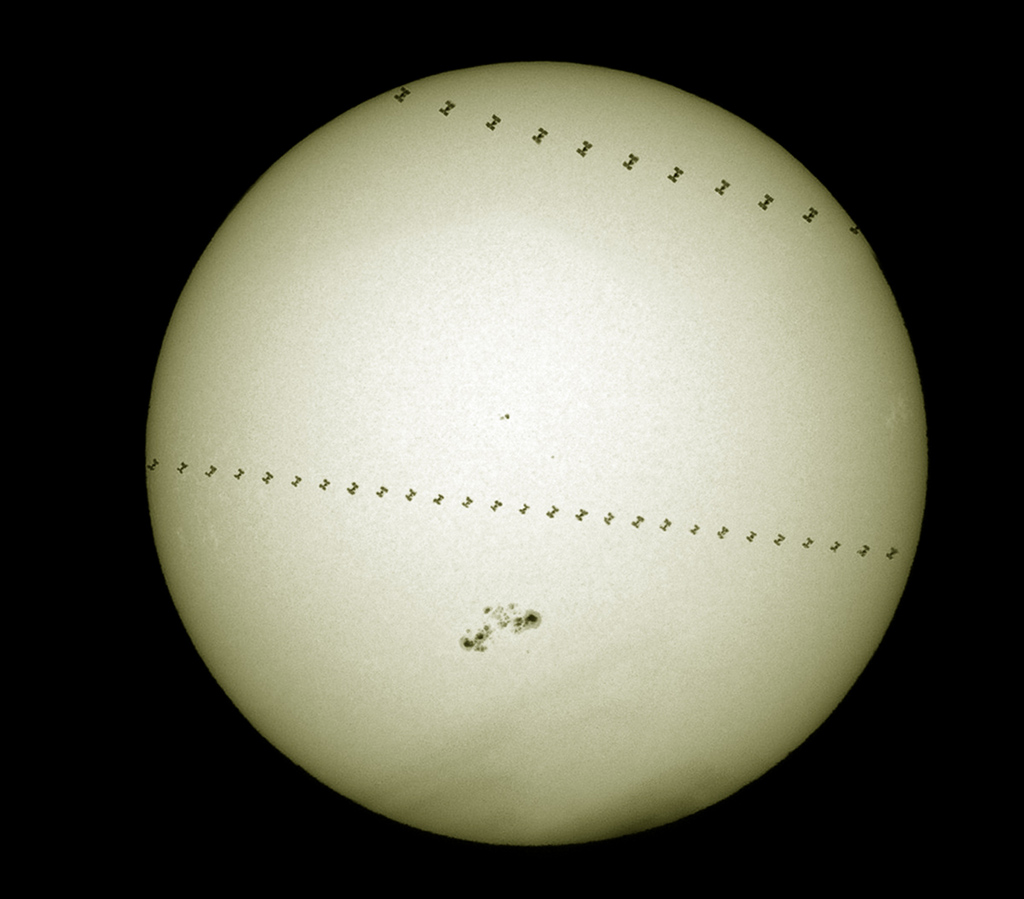
Not once, but twice the International Space Station transits the Sun on consecutive orbits of planet Earth in this video frame composite. The scene was captured on August 22 from a single well-chosen location in Schmalenbeck, Germany where the ISS created intersecting shadow paths only around 7 kilometers wide. Crossing the solar disk in a second or less, the transits themselves were separated in time by about 90 minutes, corresponding to the space station's orbital period. While the large, flare-producing sunspot group below center, AR 2403, remained a comfortable 150 million kilometers away, the distance between camera and orbiting station was 656 kilometers for its first (upper) transit and 915 kilometers for the second more central transit. In sharp silhouette the ISS is noticeably larger in angular size during the closer, first pass. Of course, tomorrow the Moon will transit the Sun. But even at well-chosen locations, its dark, central shadow just misses the Earth's surface creating a partial solar eclipse.