The Moon
The Moon is Earth’s only natural satellite—a rocky, cratered body about one‑quarter the diameter of Earth, orbiting at an average distance of approximately 384,400 km. It influences tides, stabilizes Earth’s axial tilt, and was formed about 4.5 billion years ago following a collision between Earth and a Mars-sized object.
Source: science.nasa.gov
APODs including "The Moon"
Charon and the Small Moons of Pluto
26/10/2015
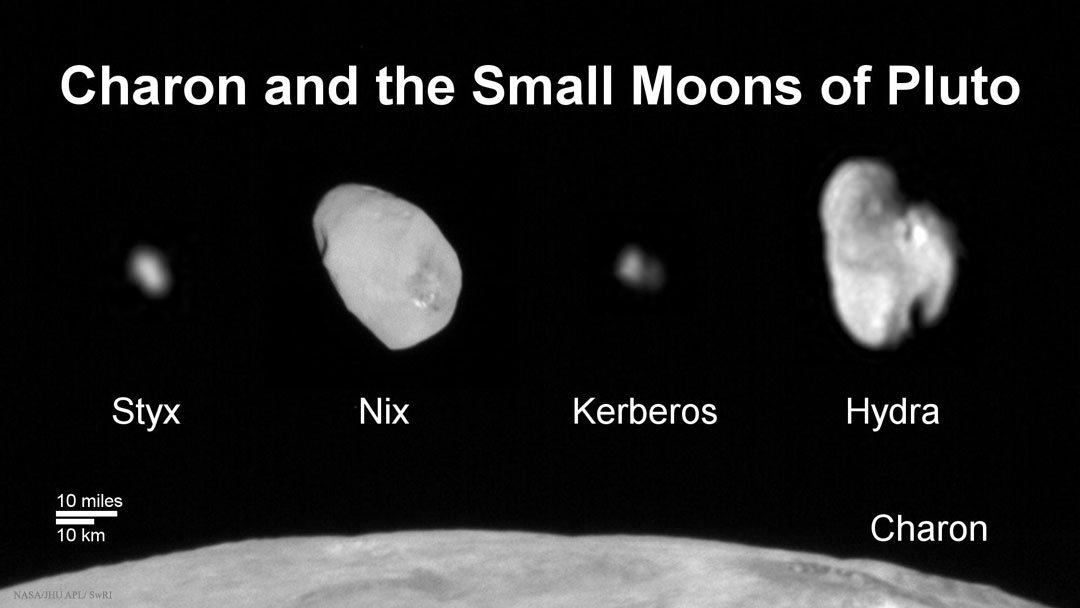
What do the moons of Pluto look like? Before a decade ago, only the largest moon Charon was known, but never imaged. As the robotic New Horizons spacecraft was prepared and launched, other moons were identified on Hubble images but remained only specks of light. Finally, this past summer, New Horizons swept right past Pluto, photographed Pluto and Charon in detail, and took the best images of Styx, Nix, Kerberos, and Hydra that it could. The featured image composite shows the results -- each moon is seen to have a distinct shape, while underlying complexity is only hinted. Even though not satisfyingly resolved, these images are likely to be the best available to humanity for some time. This is because the moons are too small and distant for contemporary Earth-based telescopes to resolve, and no new missions to the Pluto system are planned. Gallery: October's Venus, Jupiter, & Mars Conjunction