The Moon
The Moon is Earth’s only natural satellite—a rocky, cratered body about one‑quarter the diameter of Earth, orbiting at an average distance of approximately 384,400 km. It influences tides, stabilizes Earth’s axial tilt, and was formed about 4.5 billion years ago following a collision between Earth and a Mars-sized object.
Source: science.nasa.gov
APODs including "The Moon"
Penumbral Eclipse Rising
18/02/2017
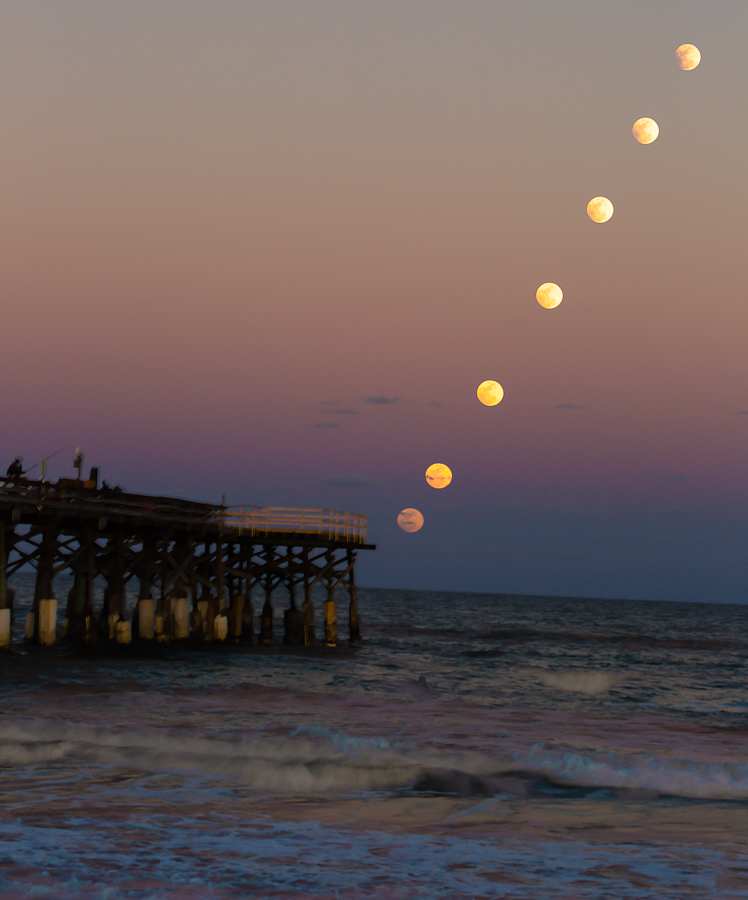
As seen from Cocoa Beach Pier, Florida, planet Earth, the Moon rose at sunset on February 10 while gliding through Earth's faint outer shadow. In progress was the first eclipse of 2017, a penumbral lunar eclipse followed in this digital stack of seaside exposures. Of course, the penumbral shadow is lighter than the planet's umbral shadow. That central, dark, shadow is easily seen on the lunar disk during a total or partial lunar eclipse. Still, in this penumbral eclipse the limb of the Moon grows just perceptibly darker as it rises above the eastern horizon. The second eclipse of 2017 could be more dramatic though. With viewing from a path across planet Earth's southern hemisphere, on February 26 there will be an annular eclipse of the Sun.