The Moon
The Moon is Earth’s only natural satellite—a rocky, cratered body about one‑quarter the diameter of Earth, orbiting at an average distance of approximately 384,400 km. It influences tides, stabilizes Earth’s axial tilt, and was formed about 4.5 billion years ago following a collision between Earth and a Mars-sized object.
Source: science.nasa.gov
APODs including "The Moon"
Saturn's Moon Pan from Cassini
13/03/2017
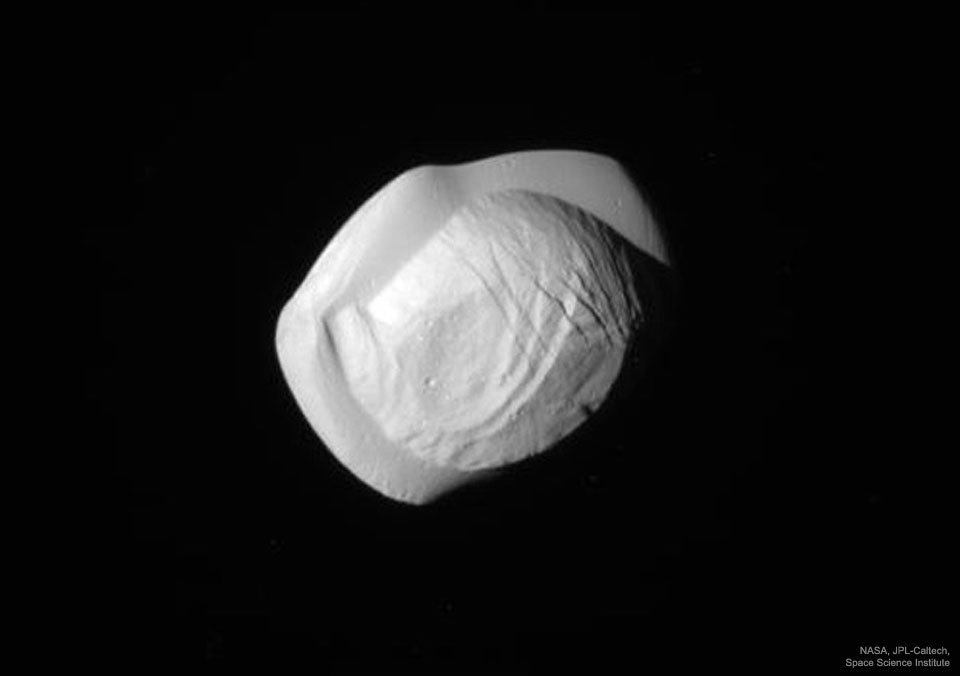
Why does Saturn's moon Pan look so odd? Images taken last week from the robotic Cassini spacecraft orbiting Saturn have resolved the moon in unprecedented detail. The surprising images reveal a moon that looks something like a walnut with a slab through its middle. Other visible features on Pan include rolling terrain, long ridges, and a few craters. Spanning 30-kilometer across, Pan orbits inside the 300-kilometer wide Encke Gap of Saturn's expansive A-ring, a gap known since the late 1800s. Next month, Cassini will be directed to pass near Saturn's massive moon Titan so it can be pulled into a final series of orbits that will take it, on occasion, completely inside Saturn's rings and prepare it to dive into Saturn's atmosphere.