The Moon
The Moon is Earth’s only natural satellite—a rocky, cratered body about one‑quarter the diameter of Earth, orbiting at an average distance of approximately 384,400 km. It influences tides, stabilizes Earth’s axial tilt, and was formed about 4.5 billion years ago following a collision between Earth and a Mars-sized object.
Source: science.nasa.gov
APODs including "The Moon"
Apollo 11: Catching Some Sun
22/07/2017
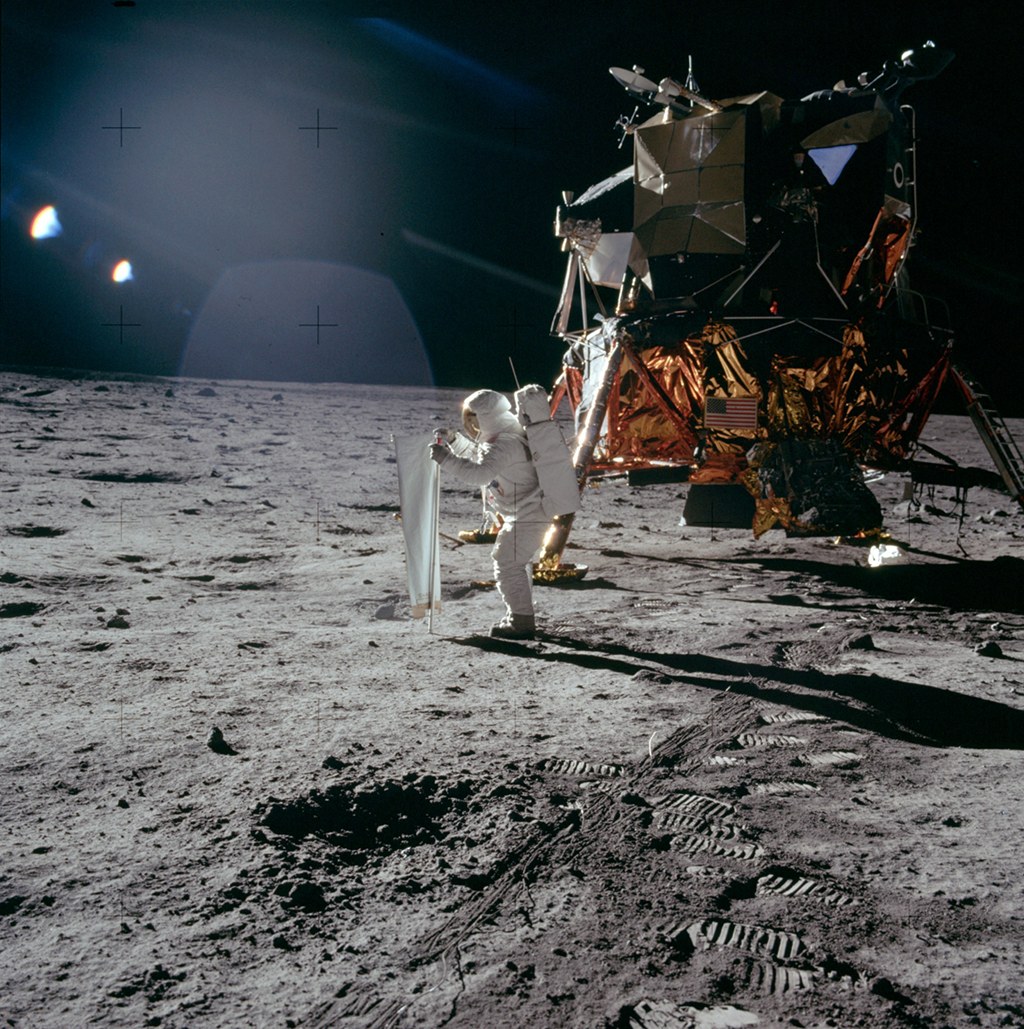
Bright sunlight glints and long dark shadows mark this image of the lunar surface. It was taken July 20, 1969 by Apollo 11 astronaut Neil Armstrong, the first to walk on the Moon. Pictured is the mission's lunar module, the Eagle, and spacesuited lunar module pilot Buzz Aldrin unfurling a long sheet of foil also known as the Solar Wind Composition Experiment. Exposed facing the Sun, the foil trapped particles streaming outward in the solar wind, catching a sample of material from the Sun itself. Along with moon rocks and lunar soil samples, the solar wind collector was returned for analysis in earthbound laboratories.