The Moon
The Moon is Earth’s only natural satellite—a rocky, cratered body about one‑quarter the diameter of Earth, orbiting at an average distance of approximately 384,400 km. It influences tides, stabilizes Earth’s axial tilt, and was formed about 4.5 billion years ago following a collision between Earth and a Mars-sized object.
Source: science.nasa.gov
APODs including "The Moon"
A Fleeting Double Eclipse of the Sun
28/08/2017
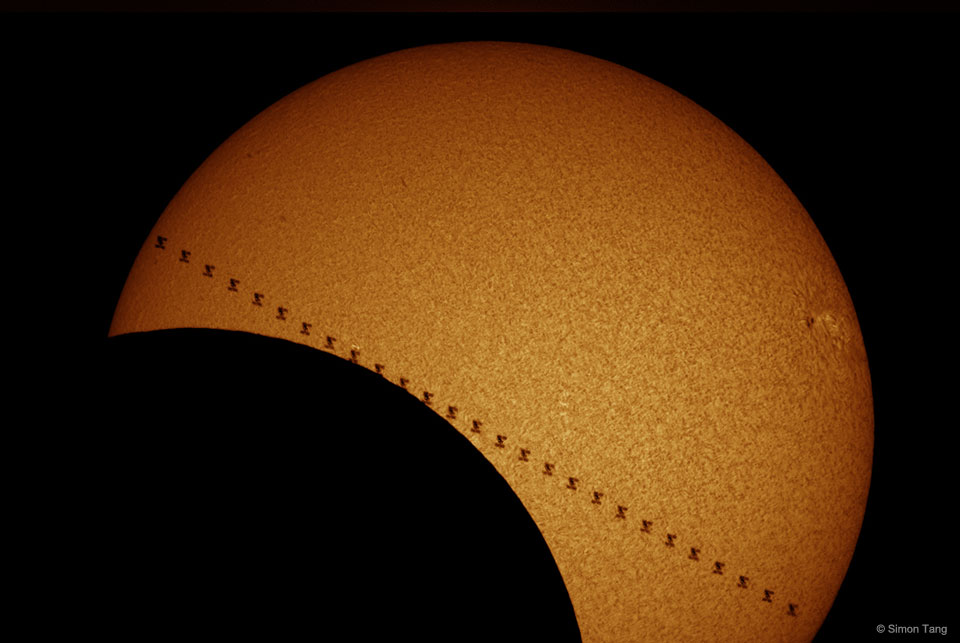
Last week, for a fraction of a second, the Sun was eclipsed twice. One week ago today, many people in North America were treated to a standard, single, partial solar eclipse. Fewer people, all congregated along a narrow path, experienced the eerie daytime darkness of a total solar eclipse. A dedicated few with fast enough camera equipment, however, were able to capture a double eclipse -- a simultaneous partial eclipse of the Sun by both the Moon and the International Space Station (ISS). The Earth-orbiting ISS crossed the Sun in less than a second, but to keep the ISS from appearing blurry, exposure times must be less than 1/1000th of a second. The featured image composite captured the ISS multiple times in succession as it zipped across the face of the Sun. The picture was taken from Huron, California in a specific color emitted by hydrogen which highlights the Sun's chromosphere, a layer hotter and higher up than the usually photographed photosphere. Follow APOD on: Facebook, Google Plus, Instagram, or Twitter