The Moon
The Moon is Earth’s only natural satellite—a rocky, cratered body about one‑quarter the diameter of Earth, orbiting at an average distance of approximately 384,400 km. It influences tides, stabilizes Earth’s axial tilt, and was formed about 4.5 billion years ago following a collision between Earth and a Mars-sized object.
Source: science.nasa.gov
APODs including "The Moon"
The Climber and the Eclipse
06/09/2017
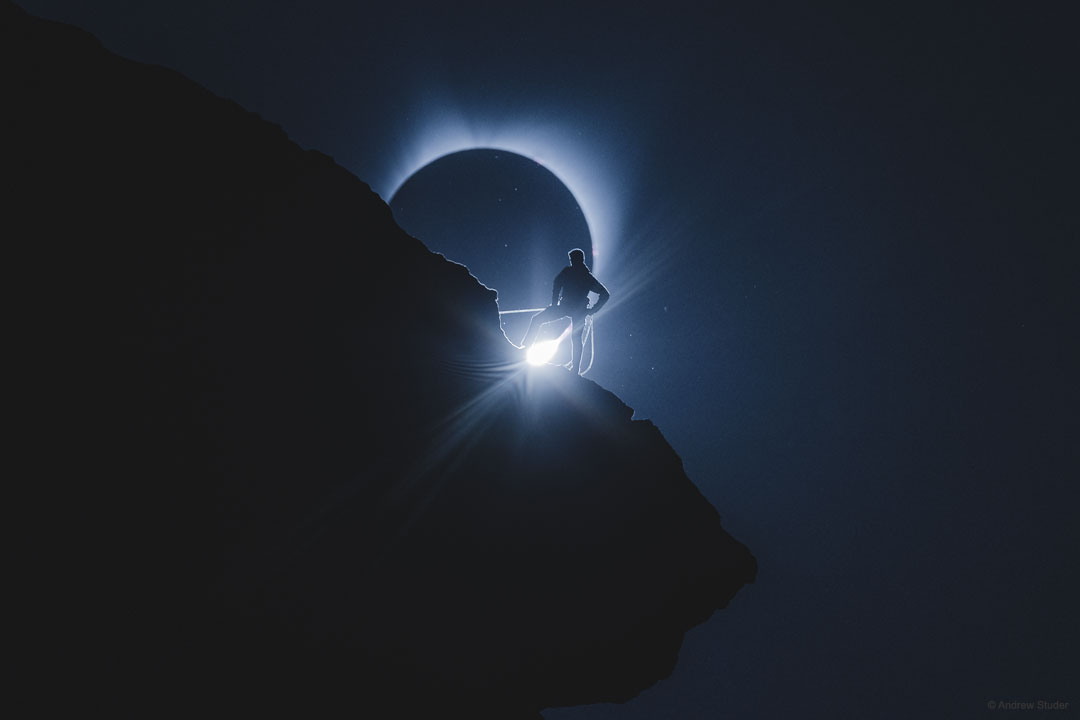
What should you do if your rock climbing picture is photobombed by a total eclipse of the Sun? Rejoice -- because your planning paid off. After months of considering different venues, and a week of scouting different locations in Oregon's Smith Rock State Park, a group of photographers and rock climbers led by Andrew Struder, Ted Hesser, Martina Tibell, and Michael Shainblum settled on picturesque 100-meter tall Monkey Face tower as the dramatic foreground for their images of the pending total solar eclipse. Tension mounted as the eclipse time approached, planned juxtapositions were scrutinized, and the placement of rock climber Tommy Smith was adjusted. Right on schedule, though, the Moon moved in front of the Sun, and Smith moved in front of the Moon, just as planned. The solar eclipse image displayed here actually shows a diamond ring, an eclipse phase when a bit of the distant Sun is still visible beyond the Moon's surface. Open Science: Browse 1,500+ codes in the Astrophysics Source Code Library