The Moon
The Moon is Earth’s only natural satellite—a rocky, cratered body about one‑quarter the diameter of Earth, orbiting at an average distance of approximately 384,400 km. It influences tides, stabilizes Earth’s axial tilt, and was formed about 4.5 billion years ago following a collision between Earth and a Mars-sized object.
Source: science.nasa.gov
APODs including "The Moon"
Layers of a Total Solar Eclipse
27/09/2017
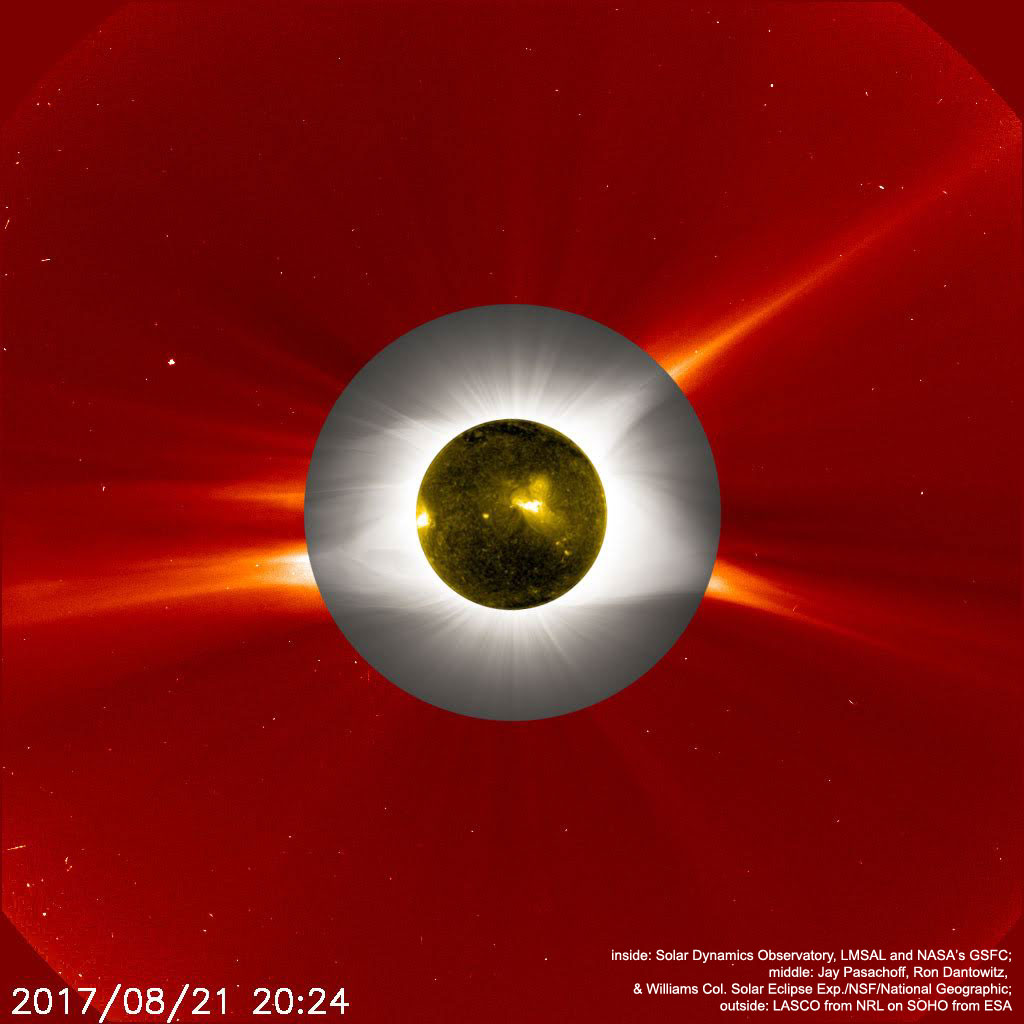
Neither rain, nor snow, nor dark of night can keep a space-based spacecraft from watching the Sun. In fact, from its vantage point 1.5 million kilometers sunward of planet Earth, NASA's SOlar Heliospheric Observatory (SOHO) can always monitor the Sun's outer atmosphere, or corona. But only during a total solar eclipse can Earth-based observers also see the lovely coronal streamers and structures - when the Moon briefly blocks the overwhelmingly bright solar surface. Then, it becomes possible to follow detailed coronal activity all the way down to the Sun's surface. In the outside layer of this composite image, SOHO's uninterrupted view of the solar corona during last month's eclipse is shown in orange hues. The middle, donut-shaped region is the corona as recorded by the Williams College Eclipse Expedition to Salem, Oregon. Simultaneously, the inner view is from NASA's Earth-orbiting Solar Dynamics Observatory, which, being outside of totality, was able to image the face of the Sun in extreme ultraviolet light, shown in gold.