The Moon
The Moon is Earth’s only natural satellite—a rocky, cratered body about one‑quarter the diameter of Earth, orbiting at an average distance of approximately 384,400 km. It influences tides, stabilizes Earth’s axial tilt, and was formed about 4.5 billion years ago following a collision between Earth and a Mars-sized object.
Source: science.nasa.gov
APODs including "The Moon"
A Horizon with Blue and Red
05/12/2017
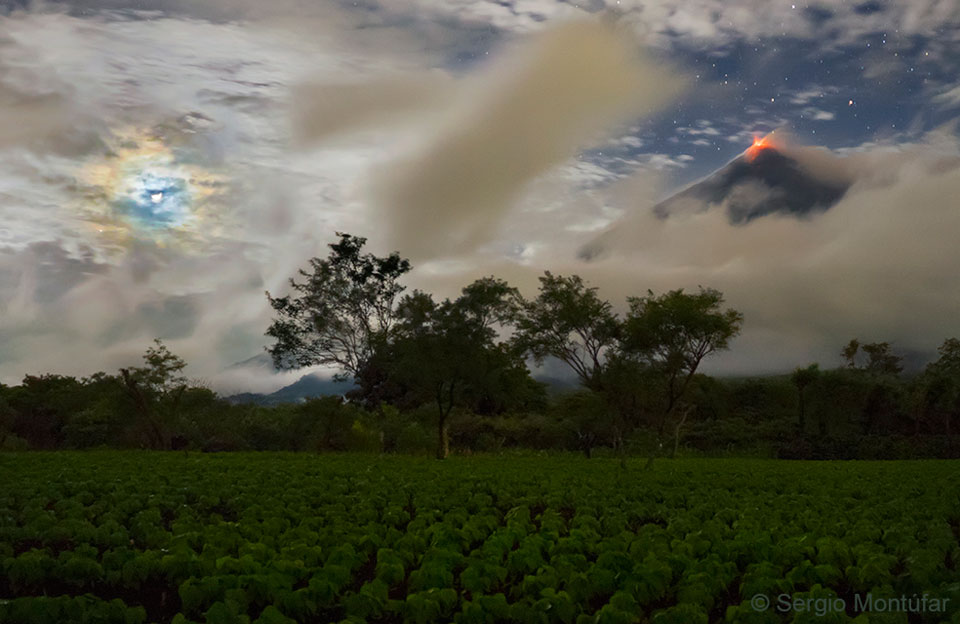
What's happening on the horizon? The horizon itself, past a spinach field in Guatemala, shows not only trees but a large volcano: the Volc�n de Fuego (Volcano of Fire). The red glow at the top of the volcano is hot lava. But your eye may also be drawn to the blue circle above the horizon on the left. This circle surrounds the Moon and, together with other colors, is called a corona. A corona is caused by diffraction of light -- here moonlight -- by small water droplets in the Earth's intervening atmosphere. A break in the clouds on the right shows stars and even the planet Saturn far beyond the volcano. Although Volc�n de Fuego frequently undergoes low-level activity, the astrophotographer considered himself lucky to capture the scene just during an explosive eruption in late September. Follow APOD on: Facebook, Google Plus, Instagram, or Twitter