The Moon
The Moon is Earth’s only natural satellite—a rocky, cratered body about one‑quarter the diameter of Earth, orbiting at an average distance of approximately 384,400 km. It influences tides, stabilizes Earth’s axial tilt, and was formed about 4.5 billion years ago following a collision between Earth and a Mars-sized object.
Source: science.nasa.gov
APODs including "The Moon"
Moonset Eclipse
01/02/2018
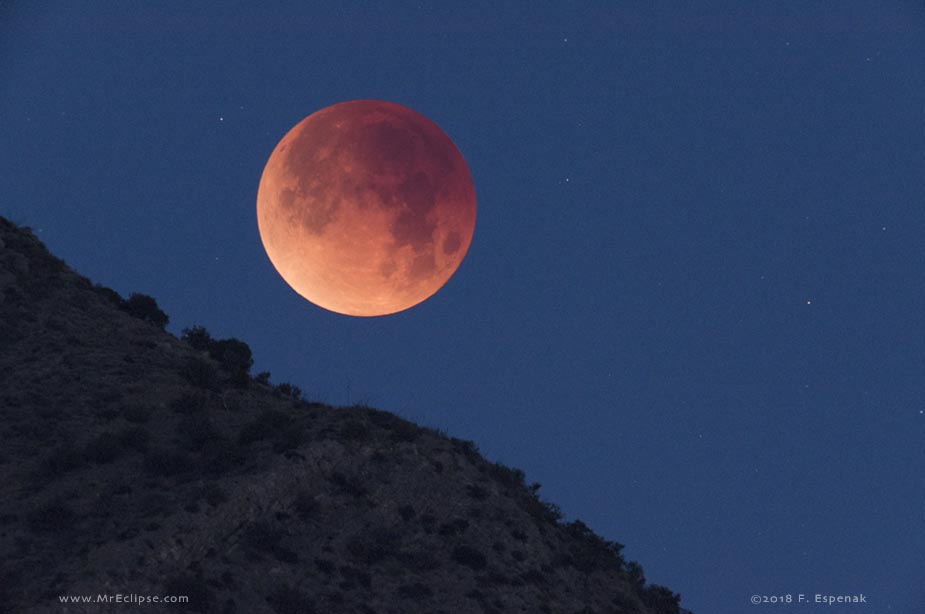
Near the closest point in its orbit, the second Full Moon of the month occurred on January 31. So did the first Total Lunar Eclipse of 2018, as the Moon slid through planet Earth's shadow. In a postcard from planet Earth, this telescopic snapshot captures the totally eclipsed Moon as it set above the western horizon and the Chiricahua Mountains of southern Arizona. The Moon's evocative reddened hue is due to sunlight scattered into the shadow. Still, the planet's shadow visibly grows darker near the center, toward the top of the lunar disk.