The Moon
The Moon is Earth’s only natural satellite—a rocky, cratered body about one‑quarter the diameter of Earth, orbiting at an average distance of approximately 384,400 km. It influences tides, stabilizes Earth’s axial tilt, and was formed about 4.5 billion years ago following a collision between Earth and a Mars-sized object.
Source: science.nasa.gov
APODs including "The Moon"
A Partial Solar Eclipse over Buenos Aires
20/02/2018
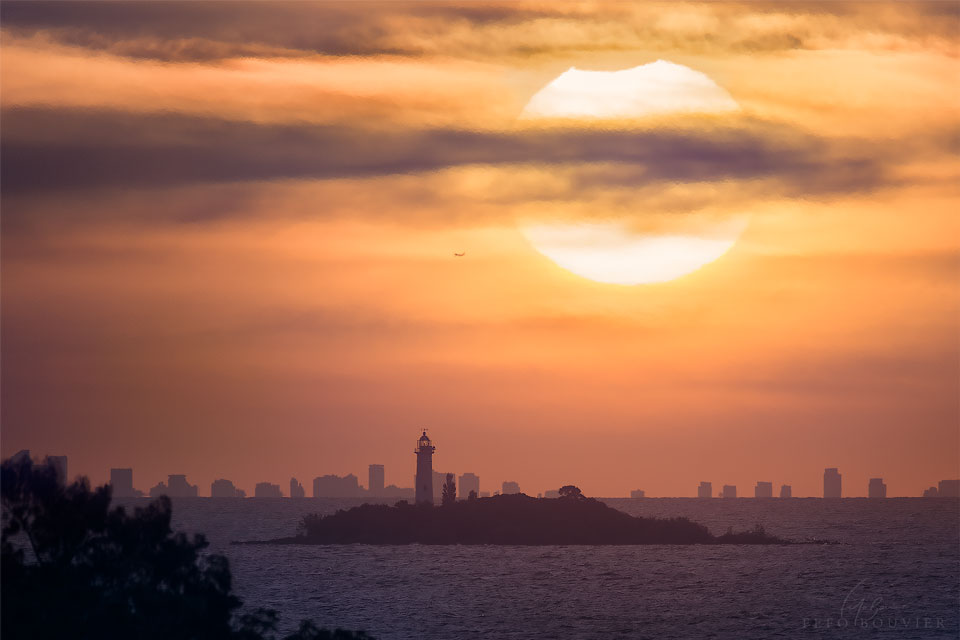
What's happened to top of the Sun? Last week, parts of Earth's southern hemisphere were treated to a partial solar eclipse, where the Moon blocks out part of the Sun. The featured image was taken toward the end of the eclipse from the coast of Uruguay overlooking Argentina's Buenos Aires. Light-house adorned Farall�n Island is seen in the foreground, and a plane is visible just to the left of the Sun. The image is actually a digital combination of two consecutive exposures taken with the same camera using the same settings -- one taken of the landscape and another of the background Sun. The next solar eclipse visible on Earth will be another partial eclipse occurring in mid-July and visible from parts of southern Australia including Tasmania.