The Moon
The Moon is Earth’s only natural satellite—a rocky, cratered body about one‑quarter the diameter of Earth, orbiting at an average distance of approximately 384,400 km. It influences tides, stabilizes Earth’s axial tilt, and was formed about 4.5 billion years ago following a collision between Earth and a Mars-sized object.
Source: science.nasa.gov
APODs including "The Moon"
Southwest Mare Fecunditatis
03/03/2018
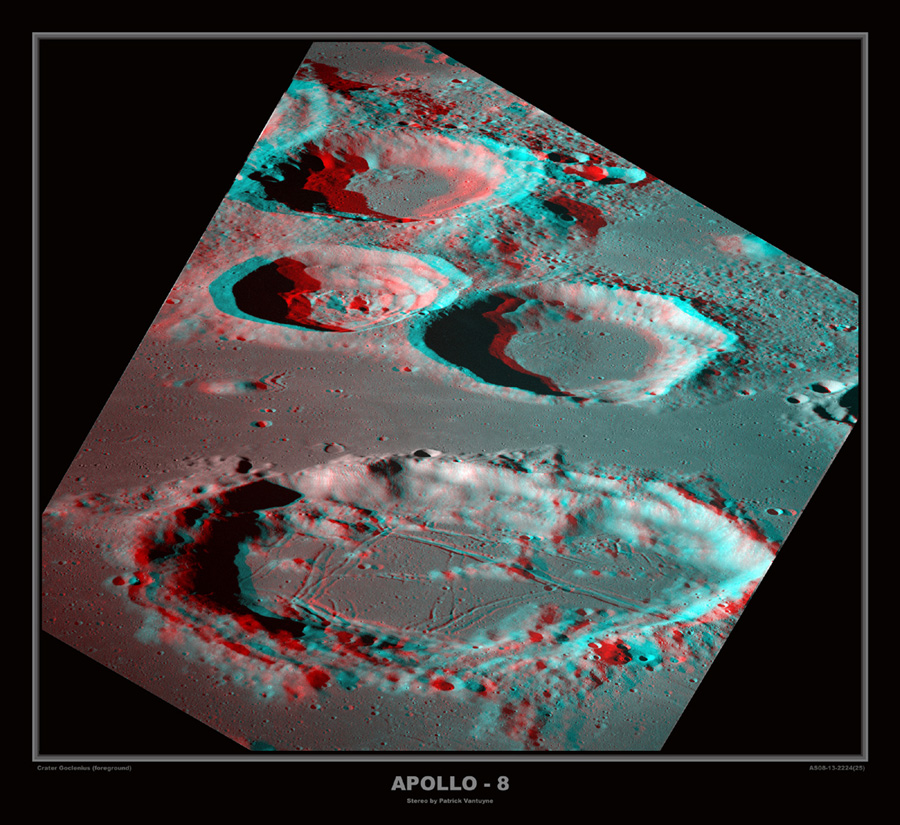
Frank Borman, James Lovell, and William Anders journeyed from Earth to the Moon and back again in December of 1968. From lunar orbit, their view of craters in southwest Mare Fecunditatis is featured in this stereo anaglyph, best experienced from armchairs on planet Earth with red/blue glasses. Goclenius is the large impact crater in the foreground. About 70 kilometers (45 miles) in diameter its lava-flooded floor is scarred by rilles or grooves, long, narrow depressions in the surface. Crossing the crater walls and central peaks the rilles were likely formed after the crater itself. In the background, the two large craters with smooth floors are Colombo A (top) and Magelhaens. Magelhaens A, the background crater with the irregular floor, is about 35 kilometers (20 miles) in diameter.