The Moon
The Moon is Earth’s only natural satellite—a rocky, cratered body about one‑quarter the diameter of Earth, orbiting at an average distance of approximately 384,400 km. It influences tides, stabilizes Earth’s axial tilt, and was formed about 4.5 billion years ago following a collision between Earth and a Mars-sized object.
Source: science.nasa.gov
APODs including "The Moon"
Twilight in a Western Sky
31/03/2018
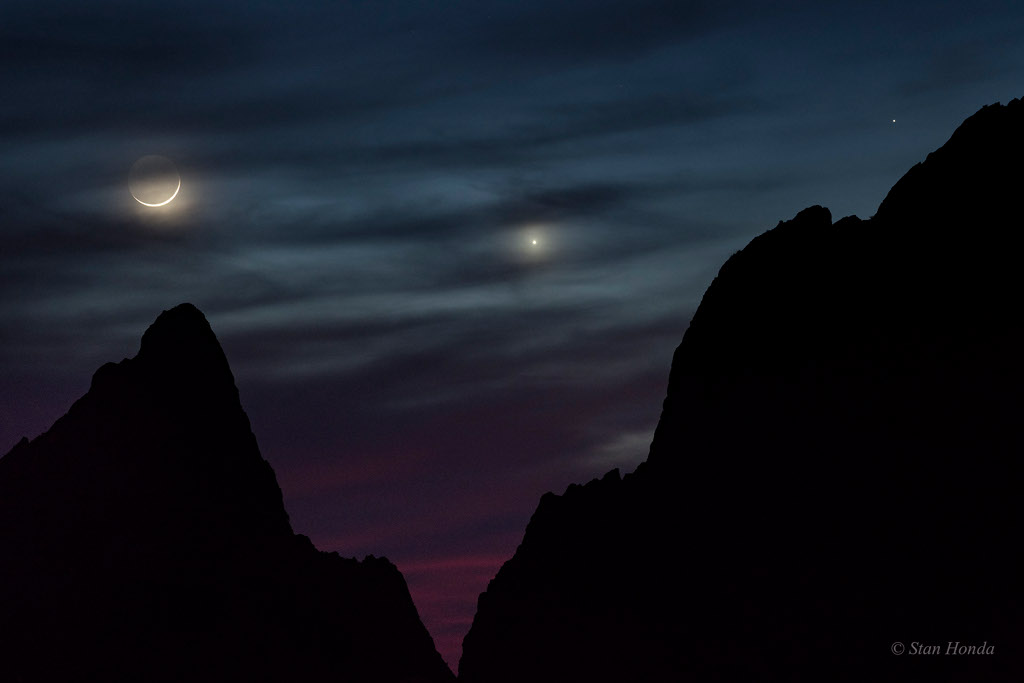
A slender crescent Moon and inner planets Venus and Mercury never wander far from the Sun in planet Earth's skies. In the fading evening twilight of March 18, they line up near the western horizon in this atmospheric skyscape. While the celestial scene was enjoyed around the world, this photo captures the trio, with fainter Mercury at the far right, above the crags of Big Bend National Park in southwest Texas. Tonight the Moon will be full though, and rise opposite the Sun. Look for it high in the sky at midnight, near bright star Spica.