The Moon
The Moon is Earth’s only natural satellite—a rocky, cratered body about one‑quarter the diameter of Earth, orbiting at an average distance of approximately 384,400 km. It influences tides, stabilizes Earth’s axial tilt, and was formed about 4.5 billion years ago following a collision between Earth and a Mars-sized object.
Source: science.nasa.gov
APODs including "The Moon"
The Unusual Boulder at Tycho's Peak
07/05/2018
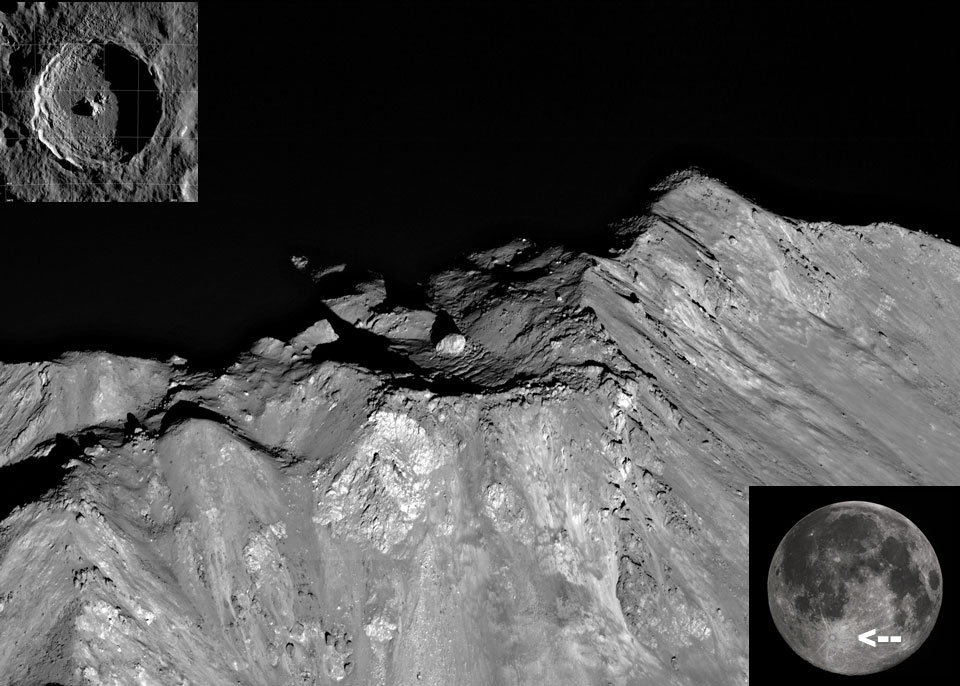
Why is there a large boulder near the center of Tycho's peak? Tycho crater on the Moon is one of the easiest features to see, visible even to the unaided eye (inset, lower right). But at the center of Tycho (inset, upper left) is a something unusual -- a 120-meter boulder. This boulder was imaged at very high resolution at sunrise, over the past decade, by the Moon-circling Lunar Reconnaissance Orbiter (LRO). The leading origin hypothesis is that that the boulder was thrown during the tremendous collision that formed Tycho crater about 110 million years ago, and by chance came back down right near the center of the newly-formed central mountain. Over the next billion years meteor impacts and moonquakes should slowly degrade Tycho's center, likely causing the central boulder to tumble 2000 meters down to the crater floor and disintegrate.