The Moon
The Moon is Earth’s only natural satellite—a rocky, cratered body about one‑quarter the diameter of Earth, orbiting at an average distance of approximately 384,400 km. It influences tides, stabilizes Earth’s axial tilt, and was formed about 4.5 billion years ago following a collision between Earth and a Mars-sized object.
Source: science.nasa.gov
APODs including "The Moon"
One Night, One Telescope, One Camera
28/07/2018
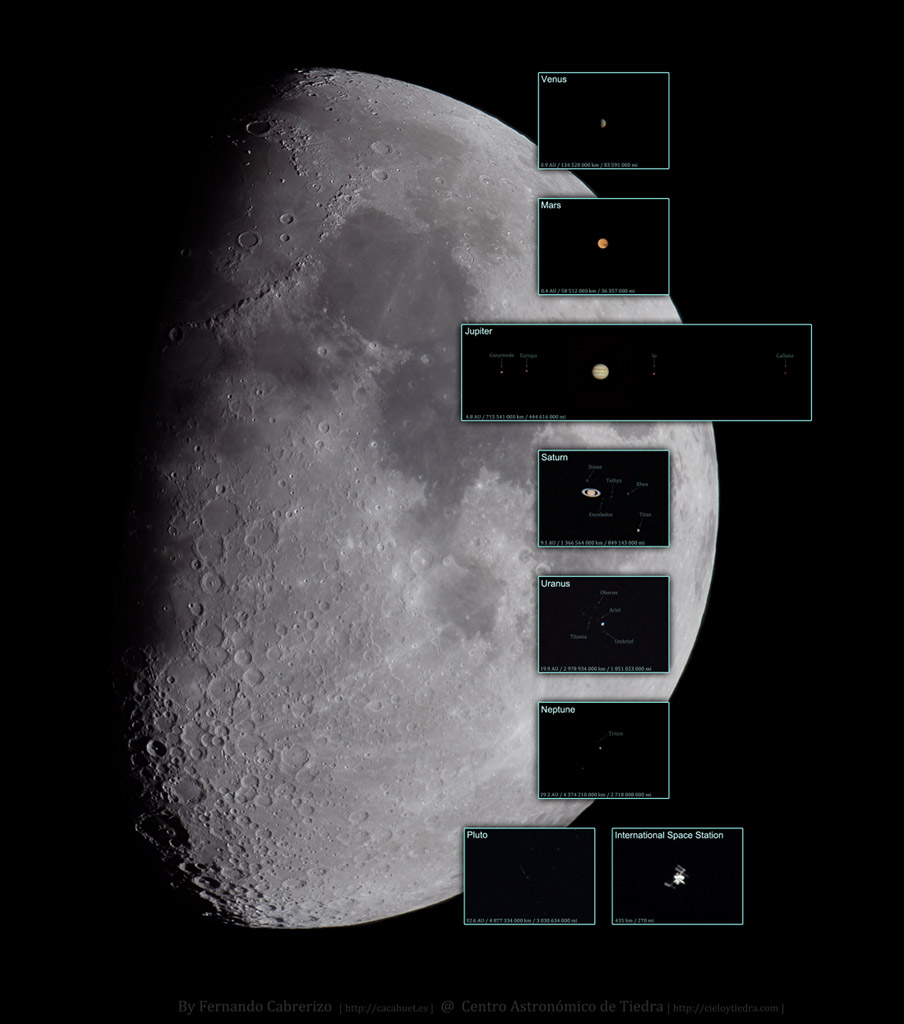
Taken on the same night, from the same place, with the same telescope and camera, these postcards from our Solar System are shown at the same scale to provide an interesting comparison of apparent sizes. Spanning about half a degree in planet Earth's sky, the Moon is a stitched mosaic of six images. The others are the result of digitally stacked frames or simple single exposures, with the real distances to the objects indicated along the bottom of each insert. Most of the Solar System's planets with their brighter moons, and Pluto were captured during the telescopic expedition, but elusive Mercury was missed because of clouds near the horizon. The International Space Station was successfully hunted, though. The night was July 21st. Telescope and camera were located at the Centro Astronomico de Tiedra Observatory in Spain. Highlights: Recent Total Lunar Eclipse