The Moon
The Moon is Earth’s only natural satellite—a rocky, cratered body about one‑quarter the diameter of Earth, orbiting at an average distance of approximately 384,400 km. It influences tides, stabilizes Earth’s axial tilt, and was formed about 4.5 billion years ago following a collision between Earth and a Mars-sized object.
Source: science.nasa.gov
APODs including "The Moon"
Comet 21P Between Rosette and Cone Nebulas
08/10/2018
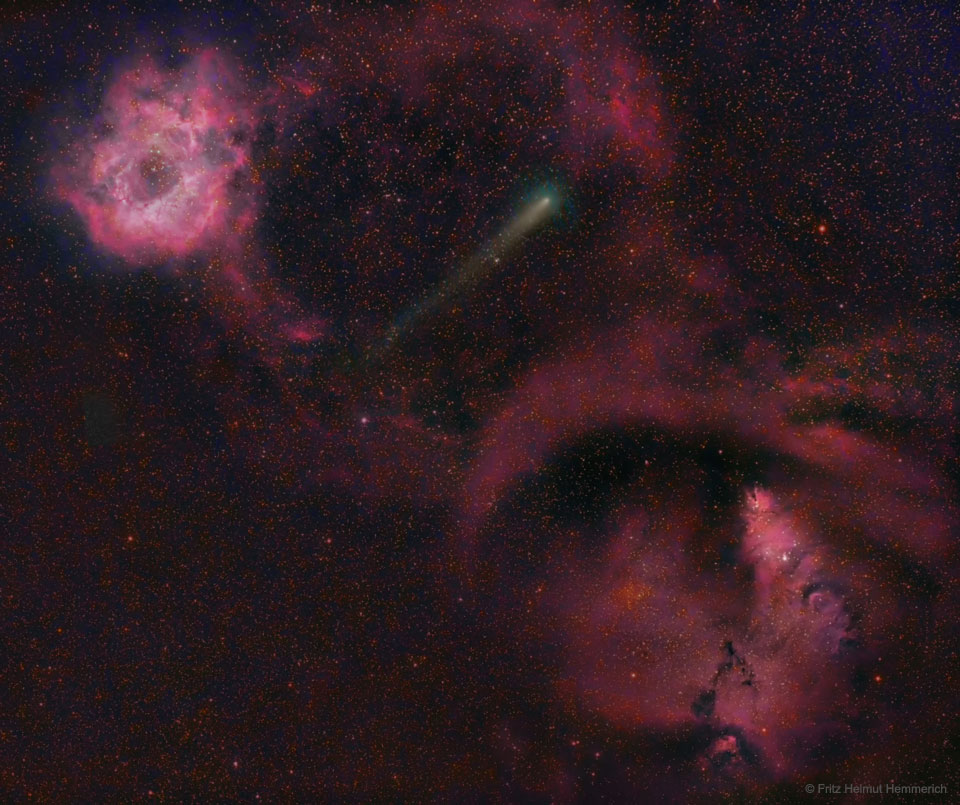
Small bits of this greenish-gray comet are expected to streak across Earth's atmosphere tonight. Specifically, debris from the eroding nucleus of Comet 21P / Giacobini-Zinner, pictured, causes the annual Draconids meteor shower, which peaks this evening. Draconid meteors are easy to enjoy this year because meteor rates will likely peak soon after sunset with the Moon's glare nearly absent. Patience may be needed, though, as last month's passing of 21P near the Earth's orbit is not expected to increase the Draconids' normal meteor rate this year of (only) a few meteors per hour. Then again, meteor rates are notoriously hard to predict, and the Draconids were quite impressive in 1933, 1946, and 2011. Featured, Comet 21P gracefully posed between the Rosette (upper left) and Cone (lower right) nebulas two weeks ago before heading back out to near the orbit of Jupiter, to return again in about six and a half years.