The Moon
The Moon is Earth’s only natural satellite—a rocky, cratered body about one‑quarter the diameter of Earth, orbiting at an average distance of approximately 384,400 km. It influences tides, stabilizes Earth’s axial tilt, and was formed about 4.5 billion years ago following a collision between Earth and a Mars-sized object.
Source: science.nasa.gov
APODs including "The Moon"
The Old Moon in the Young Moon's Arms
10/11/2018
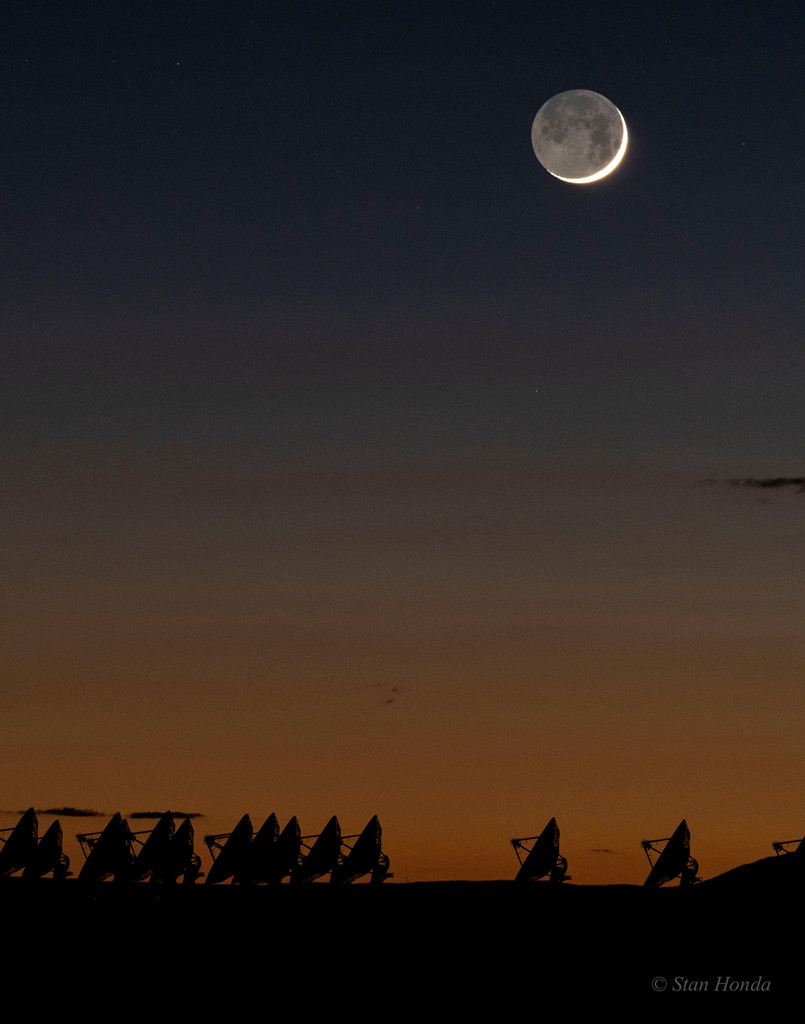
Tonight the Moon is young again, but this stunning image of a young Moon near the western horizon was taken just after sunset on October 10. On the lunar disk Earthshine, earthlight reflected from the Moon's night side, is embraced by the slim, sunlit crescent just over 2 days old. Along the horizon fading colors of twilight silhouette the radio telescope dish antennas of the Very Large Array, New Mexico, planet Earth. The view from the Moon would be stunning, too. When the Moon appears in Earth's sky as a slender crescent, a dazzlingly bright, nearly full Earth would be seen from the lunar surface. A description of earthshine, in terms of sunlight reflected by Earth's oceans in turn illuminating the Moon's dark surface, was written 500 years ago by Leonardo da Vinci.