The Moon
The Moon is Earth’s only natural satellite—a rocky, cratered body about one‑quarter the diameter of Earth, orbiting at an average distance of approximately 384,400 km. It influences tides, stabilizes Earth’s axial tilt, and was formed about 4.5 billion years ago following a collision between Earth and a Mars-sized object.
Source: science.nasa.gov
APODs including "The Moon"
An Almost Eclipse of the Moon
18/01/2020
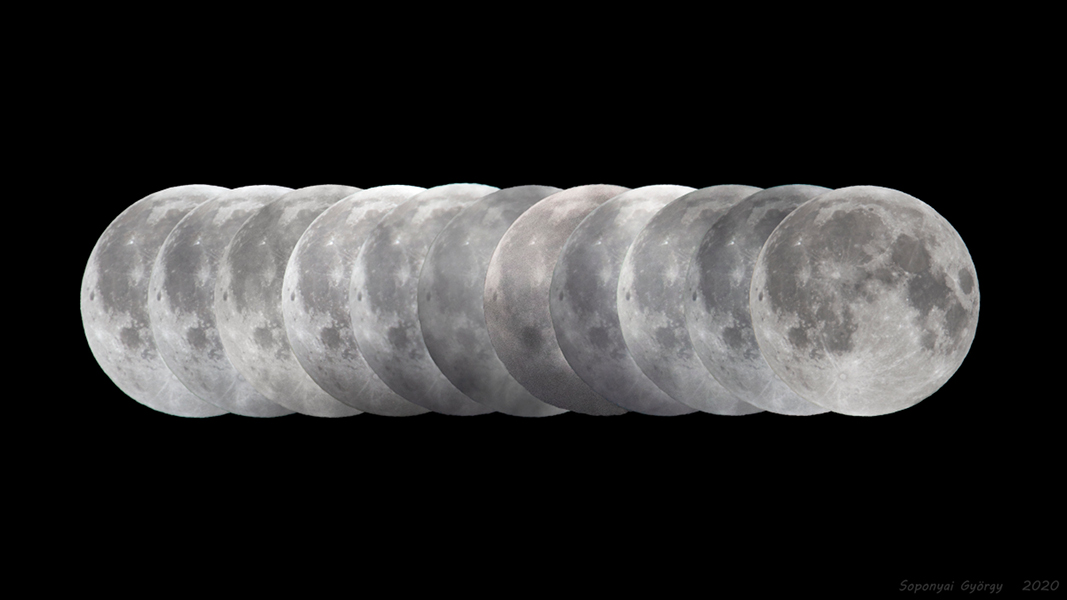
This composited series of images follows the Moon on January 10, the first Full Moon of 2020, in Hungarian skies. The lunar disk is in mid-eclipse at the center of the sequence though. It looks only slightly darker there as it passes through the light outer shadow or penumbra of planet Earth. In fact during this penumbral lunar eclipse the Moon almost crossed into the northern edge of Earth's dark central shadow or umbra. Subtle and hard to see, this penumbral lunar eclipse was the first of four lunar eclipses in 2020, all of which will be penumbral lunar eclipses.