The Moon
The Moon is Earth’s only natural satellite—a rocky, cratered body about one‑quarter the diameter of Earth, orbiting at an average distance of approximately 384,400 km. It influences tides, stabilizes Earth’s axial tilt, and was formed about 4.5 billion years ago following a collision between Earth and a Mars-sized object.
Source: science.nasa.gov
APODs including "The Moon"
Fresh Tiger Stripes on Saturn's Enceladus
27/04/2020
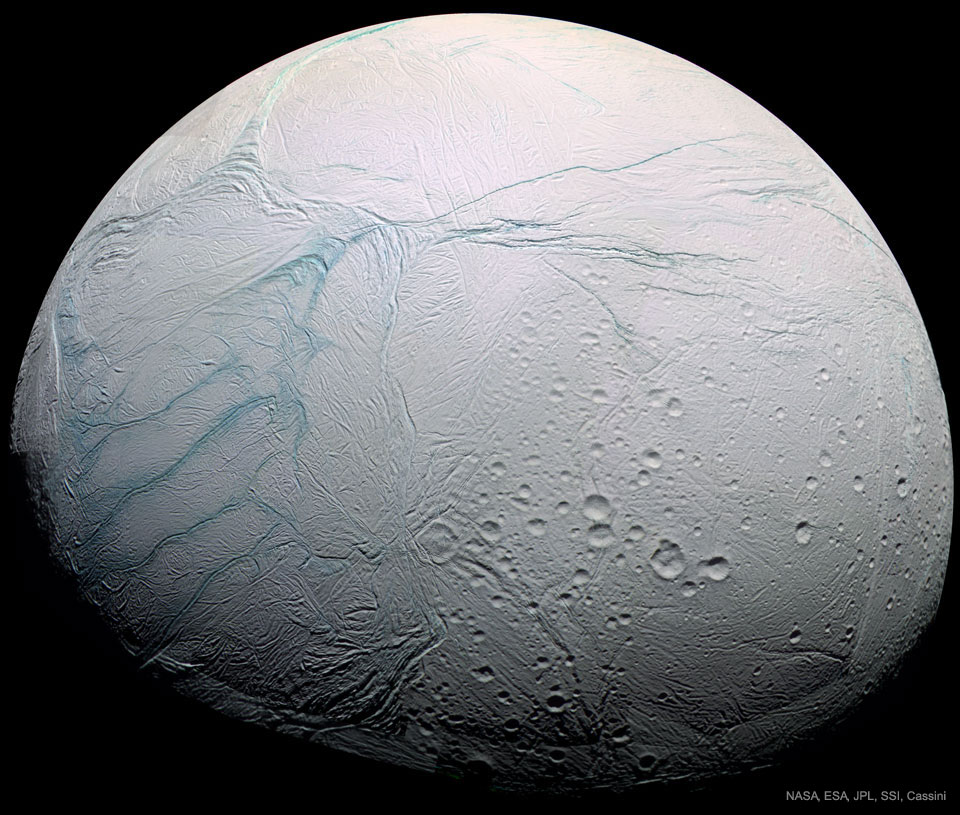
How will humanity first learn of extraterrestrial life? One possibility is to find it under the icy surface of Saturn's moon Enceladus. A reason to think that life may exist there are long features -- dubbed tiger stripes -- that are known to be spewing ice from the moon's icy interior into space. These surface cracks create clouds of fine ice particles over the moon's South Pole and create Saturn's mysterious E-ring. Evidence for this has come from the robot Cassini spacecraft that orbited Saturn from 2004 to 2017. Pictured here, a high resolution image of Enceladus is shown from a close flyby. The unusual surface tiger stripes are shown in false-color blue. Why Enceladus is active remains a mystery, as the neighboring moon Mimas, approximately the same size, appears quite dead. A recent analysis of ejected ice grains has yielded evidence that complex organic molecules exist inside Enceladus. These large carbon-rich molecules bolster -- but do not prove -- that oceans under Enceladus' surface could contain life. Another Solar System moon that might contain underground life is Europa. Experts Debate: How will humanity first discover ET life?